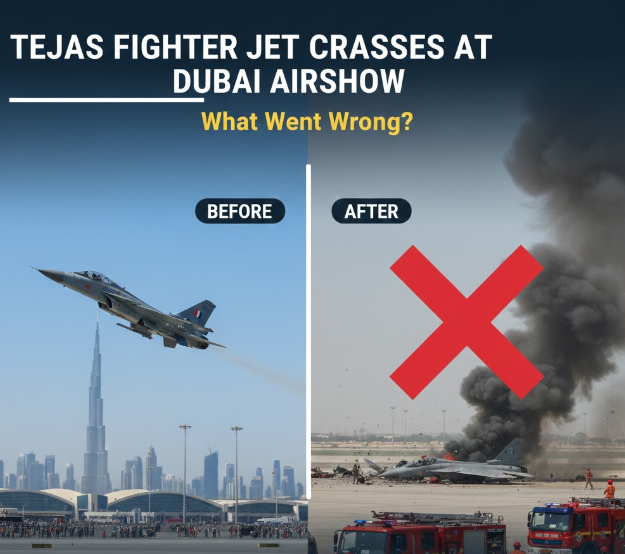
On Friday, 21 November 2025, the Dubai Airshow turned tragic when an Indian Air Force Tejas fighter jet crashed during an aerobatic display killing the pilot. The aircraft crashed in front of spectators at Al Maktoum International Airport, creating a fireball and a swirl of black smoke. What should have been a moment of national pride turned into grief in an instant.
This was not just any crash. The Tejas is India’s domestically designed light combat aircraft, and this accident raises serious questions about the aircraft’s performance, pilot safety, and the future of India’s indigenous aviation ambitions.
In this report, we’ll walk through what is known so far: how the crash happened, how the Indian Air Force (IAF) and Indian government have reacted, and what this incident might mean for India’s aerospace program.
What Happened on That Fateful Friday
The Crash During an Aerial Display
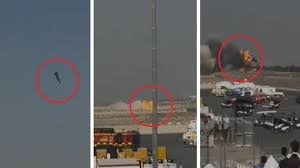
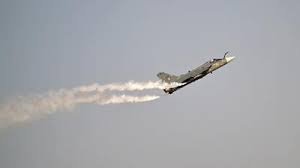 Witnesses at the airshow say the Tejas was performing a low-altitude manoeuvre when something went wrong. It reportedly lost stability during a roll or negative-G turn. Eyewitness video shows the jet trailing smoke before it plummeted and exploded near the runway. Emergency teams rushed in, but the pilot did not eject or survive.
The timing of the crash during a public demonstration immediately amplified its impact. Airshows are organized meticulously, and every aerobatic element is rehearsed again and again. Yet, even with all precautions, flying jets at low altitude remains risky.
Immediate Emergency Response
Rescue and fire-fighting teams were quick to respond. Vehicles from the Dubai airport fire service surrounded the wreckage, and emergency responders combed through the debris. Spectators were visibly shaken, and some had filmed horrifying footage of the plane going down.
According to UAE official sources, the emergency response was prompt, but sadly, the pilot could not be saved.
On the Indian side, within hours, the IAF announced that the pilot had died in the crash. They confirmed the incident and expressed sorrow, adding that a “court of inquiry” was being set up to figure out exactly what went wrong.
Why This Crash Is Especially Significant for India
This is not just a military aviation accident it is a blow to India’s strategic and symbolic ambitions in aerospace.
The Tejas Is a Huge Deal
Tejas is far more than a plane in the Indian context. It represents Make-in-India in defense. Developed by Hindustan Aeronautics Limited (HAL) and the Aeronautical Development Agency, it has been pitched as India’s future combat jet locally made, locally maintained.
Losing a Tejas in a high-profile display like the Dubai Airshow raises concern beyond just loss of life:
-
It tests global confidence in Tejas as a symbol of indigenous strength.
-
It could affect export potential. International partners may watch more closely now.
-
It could shake morale within the IAF and HAL, especially among those who have invested in the program’s long-term success.
Airshow Diplomacy
Airshows like Dubai’s are not just technical exhibitions. They are diplomatic stages. Nations use them to showcase their aerospace capabilities, strike strategic partnerships, and attract buyers.
For India to have a crash on that stage a jet that its own defense establishment and HAL have championed—makes this incident politically and diplomatically significant.
India’s Military Reaction: IAF and HAL
IAF’s Statement and Inquiry
The Indian Air Force moved quickly:
-
They confirmed the crash and announced that the pilot was killed.
-
They ordered a court of inquiry, which is standard after major accidents but in this case, the stakes are higher.
-
The IAF expressed deep regret and extended condolences to the pilot’s family, calling him “brave” and highly skilled.
A court of inquiry will typically examine:
-
Flight data and logs
-
Maintenance history of the aircraft
-
Pilot’s training and past sorties
-
Possible mechanical or structural failures
-
The exact sequence of manoeuvres during the crash
Given that the aircraft reportedly lost control at low altitude, there will likely be a special focus on how recoverable the situation was, and whether structural or system failure played a role.
HAL’s Response
Hindustan Aeronautics Limited (HAL), the manufacturer of the Tejas, also issued a statement. It expressed deep sorrow over the loss and praised the courage and professionalism of the pilot. HAL will almost certainly cooperate fully with the inquiry, because a crash like this affects not just safety perception but also future contracts.
India’s Political Reaction
The crash has already become a matter of national conversation. Among top reactions:
-
Defence Minister: The minister expressed grief publicly and reaffirmed the importance of a thorough investigation.
-
Political Leaders: There have been calls for transparency from both opposition and government benches. Many want to know whether this was simply an accident or something that could have been prevented.
-
Media and Public: News outlets are replaying crash visuals and raising critical questions. Social media is full of shock, sorrow, and concern for India’s defense manufacturing reputation.
The government also previously addressed misleading social media claims just before the crash. A day earlier, some viral posts suggested a fuel leak in Tejas. The Press Information Bureau clarified that what people saw was condensed water drainage, not a mechanical fault. That statement, in hindsight, takes on new significance.
Hypotheses on What Might Have Gone Wrong
 While we won’t know for sure until the inquiry is complete, several plausible scenarios are emerging among aviation and defense analysts:
-
Pilot Error During Demonstration
-
Airshow manoeuvres are riskier than combat flights simply because of the low altitude.
-
A small miscalculation in a roll or turn, especially with negative G, might have made recovery impossible.
-
-
Technical or Mechanical Failure
-
Something may have failed mid-flight: control surfaces, hydraulics, or flight systems.
-
Given the smoke trail reported by witnesses, there may have been an engine or structural failure.
-
-
Ejection Failure or Insufficient Time
-
Eyewitnesses claim there was no ejection. That could mean the pilot didn’t have time to eject or something went wrong with the ejection system.
-
Low-altitude ejection is highly risky you may not get enough height for the parachute to deploy.
-
-
Tejas Structural Limits
-
This crash could raise difficult questions about whether the Tejas is being pushed too far in airshows.
-
Demonstration jets are often expected to perform aerobatic routines that weren’t originally part of a combat aircraft’s core job.
-
Bigger Strategic Implications
This crash is more than a tragedy it could influence India’s long-term defense planning.
Impact on Tejas Export Plans
India has long eyed export markets for Tejas. Several countries had shown interest in buying the LCA for training or light combat roles. A high-profile crash might raise red flags, especially for foreign defense buyers concerned about safety and reliability.
Budget and Development Pressure on HAL
HAL may face pressure to accelerate improvements, safety audits, and design modifications. This could increase costs, delay production, or force HAL to change how it certifies aircraft for public demos.
Pilot Safety and Training Review
The IAF may revise how it conducts airshow training, particularly the protocols for aerobatic routines. It could tighten safety margins, restrict dangerous manoeuvres, or require more thorough risk assessment.
Public Trust and Domestic Morale
Given the symbolic weight of Tejas, this incident could affect public trust in India’s defense “made in India” story. It also hits morale within the IAF and could cause unease among pilots who fly these aircraft, especially in demonstration units.
Human Cost: Remembering the Pilot
The most tragic part of this accident is the loss of the pilot. Military pilots don’t just fly planes — they accept risk as part of their mission. Public displays add another layer of pressure: high crowd visibility, limited error tolerance, and difficult manoeuvres.
For the fallen pilot’s family, this is a personal tragedy. For the IAF, it’s a loss of a trained, presumably highly skilled flyer. For HAL and aviation engineers, it’s a sobering reminder that every test, every demonstration, entails real danger.
What’s Next: The Road Ahead
Here’s what should (and likely will) happen in the coming days and weeks:
-
Complete the Inquiry
-
The court of inquiry must deliver a thorough report: root cause, contributing factors, and recommended changes.
-
Its findings could influence Tejas design, pilot training, and how the IAF uses demo aircraft.
-
-
Review Safety Protocols
-
The IAF might revise its display routines at airshows.
-
HAL and the IAF may evaluate whether the Tejas is being flown too aggressively in demonstrations.
-
-
Communication with Stakeholders
-
The Indian government must manage both national and international press carefully.
-
HAL needs to maintain transparency for its export ambitions.
-
The IAF should communicate its commitment to pilot safety.
-
-
Long-Term Reforms
-
This may spur broader reforms in India’s defense aviation: improved simulators, stricter certification, better maintenance, and safer operating envelopes.
-
The loss may also drive investment in newer Tejas variants or other indigenous projects.
-
A Moment of Reflection
The crash of the Tejas on 21 November 2025 is tragic in the most literal sense a pilot lost his life. But beyond that, it’s a moment of reckoning for India’s aerospace ambitions.
Tejas is supposed to be a symbol of independence and innovation. The fact that this happened during an international airshow a place meant to celebrate innovation is deeply ironic.
Yet, India has survived bigger setbacks. If handled well, this tragedy could lead to meaningful improvements: in safety, in accountability, in design, and in how India projects its defense technology to the world. But that depends on what happens next how the inquiry is conducted, how HAL learns from the accident, and how the IAF adapts. For now, the country mourns. But it must also prepare. Because the sky is not just a stage; it’s also a frontier. And how we navigate it matters not just for prestige, but for future generations of aviators and engineers. To know more subscribe Jatininfo.in now.