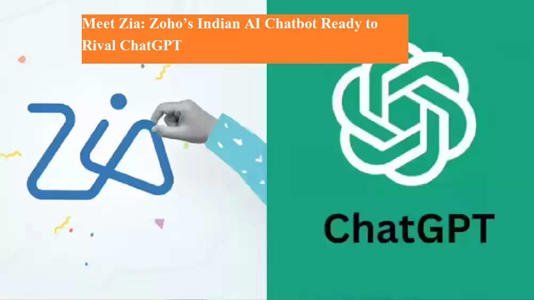
Artificial intelligence is evolving fast and becoming more deeply integrated into everyday workflows. While most headlines focus on global players like ChatGPT, OpenAI and others, Indian-origin software company Zoho Corporation is positioning its in-house assistant, Zia, to become a serious contender especially for enterprise use, regional adaptation, and data privacy.
With the recent launch of its own large language model (LLM) and an ecosystem of AI agents, Zia is ready to challenge the status quo. This blog will explore the origins of Zia, its key capabilities, how it compares with ChatGPT, why it’s significant in the Indian context (and beyond), the challenges ahead, and what it means for businesses and users. Let’s explore which one is better and easy to use ChatGPT or Zia
What is Zia? The Basics
 Zia is Zoho’s AI assistant and chatbot platform that has been embedded across Zoho’s product suite for some years, and recently evolved into a full-blown large language model, agent platform and business automation engine.
-
At a fundamental level, Zia is embedded inside applications like Zoho CRM, Zoho Desk, Zoho Mail, Zoho Projects and more helping users ask natural-language questions, summarise content, automate tasks, detect anomalies, and generate insights.
-
In July 2025, Zoho announced the launch of Zia LLM, its own large language model (in 1.3B, 2.6B and 7B parameter sizes) tailored for business use cases, emphasising privacy, governance and cost-efficiency.
-
Zoho also introduced Zia Agents, a platform wherein pre-built and custom agents can be deployed to handle specific workflows (sales development, HR screening, IT help-desk, etc.).
Thus, Zia has transitioned from a feature inside Zoho apps into an AI platform that could stand on its own — and potentially compete with ChatGPT-style assistants, especially in enterprise contexts.
Key Capabilities of Zia
What can Zia do? Several capabilities make it noteworthy:
1. Conversational Assistance
Zia can understand plain language queries and respond contextually. For example, in Zoho CRM you can ask: “What is the win-probability of deal XYZ this month?” and Zia will fetch the data, score the deal and provide insights.
In Zoho Projects, you can ask things like “List all overdue tasks assigned to me” and Zia will filter data accordingly.
2. Generative Writing & Summarisation
In apps such as Zoho Mail and Zoho Writer, Zia helps generate email content, summarise long threads, auto-complete sentences, adjust tone, and refine style.
3. Agentic Automation
With Zia Agents and its Agent Studio/Marketplace, Zoho allows businesses to build end-to-end workflows: an agent may screen resumes, sort leads, update CRM records, escalate issues, all with minimal human intervention.
4. Business-Context Awareness and Privacy
Zoho emphasises that Zia’s differentiator is its context connected to Zoho’s suite and its full ownership of tech stack data centres, app layer, etc. Zia is positioned as “private AI” for businesses, meaning user data stays inside Zoho’s ecosystem rather than feeding third-party models.
5. Indian Language & Localisation Focus
In its July 2025 LLM announcement, Zoho included features like speech recognition models for English and Hindi, and expressed intent to add more Indian languages for AI tasks an important localisation advantage.
Zia versus ChatGPT: How They Compare
 Given that ChatGPT is the best-recognized name in conversational AI, how does Zia measure up?
Similarities
-
Both use large language models and generative AI to respond to prompts, generate content, summarise text, answer questions.
-
Both are embedded into workflows: ChatGPT via its API and integrations; Zia via Zoho’s apps and agent platform.
-
Both have enterprise offerings: ChatGPT Enterprise, OpenAI’s API; Zia LLM, Zia Agents for business workflows.
Differences
-
Ownership and Stack: Zoho claims full control over its stack and data flow (data centers, app layer) whereas ChatGPT/Open AI uses its own infrastructure and third-party clouds. “Private AI” is a key Zoho message.
-
Integration into Business Ops: Zia is deeply integrated into Zoho’s business suite CRM, Mail, Projects, etc so its strengths lean toward enterprise workflows rather than standalone general chat. OpenAI’s ChatGPT is more general purpose.
-
Localisation & Indian Focus: Zia emphasises Indian market needs (Hindi language support, Indian business use cases, cost sensitivity) which may give it an edge in India. ChatGPT is global but doesn’t always localise to regional business norms or languages in the same way.
-
Cost & Licensing Model: Zoho emphasises that its AI is “built-in” rather than an expensive addon per usage this could translate into more predictable cost for businesses.
-
Agentic Workflow Capabilities: While ChatGPT has plugins and actions, Zia’s agent framework is built into the business workflow logic (Agent Studio, pre-built agents). That may make it more operational for business process automation.
Why Zia Matters for Indian Businesses (and Beyond)
Zia’s rise is particularly significant in the Indian and emerging-markets context. Here’s why:
1. Domestic AI Capability
With increasing concerns around data sovereignty, localisation and cost, an Indian-origin LLM and assistant like Zia gives businesses a “home-grown” alternative to dependence on foreign models. The July 2025 LLM launch positioned Zia as part of India’s AI race.
2. SME & Mid-Market Focus
Zoho is widely used by small and mid-sized businesses globally. Embedding AI across its apps means many SMEs can access AI capabilities without massive investment. Rather than building custom models, they can use Zia’s built-in power.
3. Workflow Automation and Productivity Gains
As businesses look to reduce cost, automate repetitive tasks, and gain insights from their data, Zia’s contextual business focus (CRM, support, projects) makes it highly relevant. For example, Zia can detect sales anomalies, suggest next best actions, summarise support ticket trends functions that directly impact operations.
4. Multi-Language & Emerging Market Support
India is a multilingual country. AI that supports Hindi and other regional languages, particularly for voice recognition and AI assistants, is a key differentiator. Zia’s roadmap mentions speech recognition models for English & Hindi and plans for more.
5. Data Privacy & Local Cloud Advantage
Zoho emphasises that data remains in its stack, reducing reliance on third-party cloud models and data processors. For businesses concerned about compliance, data sharing and governance, this is meaningful.
Use-Cases and Industry Examples of Zia
Here are tangible examples of how Zia is being applied:
-
Sales Teams: In Zoho CRM, Zia analyses leads and deals, predicts win-probabilities, suggests next best actions, identifies email sentiment and automates tasks.
-
Customer Support: In Zoho Desk, Zia summarises tickets, tags issues by topic, proposes responses, and helps bring contextual knowledge to agents, improving response time and quality.
-
Content Creation: In Zoho Mail, Writer, Social, Zia helps generate emails, posts, regenerate content, summarise messages, propose hashtags and emoji suggestions in social media workflows.
-
Custom Agents: Using Zia Agent Studio, businesses can assemble bots HR bots to screen candidates, IT help-desk bots to resolve tickets, workflow bots to trigger events based on data. The Agent Marketplace offers pre-built agents to accelerate deployment.
These use-cases show the focus is less on general chat (though Zia can chat) and more on embedded productivity and automation.
Challenges and What Zia Must Address
 Although promising, Zia faces some key hurdles if it is to truly rival ChatGPT and grow beyond Zoho’s ecosystem.
1. Model Quality & Generalisation
ChatGPT has been iterated for broad global use, huge infrastructure and vast training data. Zia’s LLM is newer and business-focused; it must match or exceed performance, reliability and safety to win trust in more general domains.
2. Ecosystem and Developer Community
One of ChatGPT’s strengths is its plugin ecosystem, large community and breadth of integrations. Zia needs to build developer momentum, partner integrations, third-party marketplaces and APIs if it’s to grow beyond Zoho’s apps.
3. Adoption Beyond Zoho Users
Currently Zia is embedded inside Zoho’s apps. To compete broadly, Zia must be available outside Zoho’s ecosystem, or integrate widely, so non-Zoho users can adopt it.
4. Trust, Bias, Ethics and Data Safety
AI assistants increasingly face scrutiny around hallucinations, bias, misuse. For enterprise in particular, accuracy, audit-trail, data governance matter. Zia’s proposition of “private AI” helps but it must demonstrate real-world compliance, transparency and ethical safeguards.
5. Market Competition
Even in the Indian context, global AI players (OpenAI, ChatGPT, Google, Meta) and local startups will compete. Differentiation will matter. Zia must continue to innovate faster and be usable for business and consumer workflows.
6. Pricing, Scale and Infrastructure
Running LLMs, agents, voice recognition models across languages is resource intensive. Managing cost, latency, scale and user experience is a non-trivial engineering challenge.
What to Expect Next: Zia’s Roadmap and Strategic Moves
Based on announcements and analyst commentary, some of the next milestones for Zia include:
-
Expansion of language support: More Indian languages such as Hindi, Tamil, Telugu, Kannada for voice and chat AIs.
-
Marketplace growth: Zia Agent Marketplace to allow partners and developers to build and deploy their own agents and workflows.
-
Deployment of larger parameter models: While current sizes are 1.3B, 2.6B, 7B parameters, Zoho may scale these models or build larger sizes for more complex reasoning.
-
Consumer-facing or mixed environment offerings: While current focus is enterprise, there may be offerings for SMBs and even personal productivity.
-
Deeper integration with Zoho’s ecosystem: Zia being able to surface insights across CRM + Mail + Projects + Desk seamlessly.
-
Improved agentic automation: Agents that perform multi-step tasks autonomously, bridging gaps between data, actions and workflows.
Implications for Users and Businesses
For users and businesses evaluating Zia, here are key considerations:
For Businesses
-
If you already use Zoho’s suite, Zia offers an incremental AI upgrade with minimal disruption.
-
Evaluate whether you need custom agents (via Agent Studio) or standard capabilities suffice.
-
Consider data governance and privacy Zoho emphasises data residency and ownership, so align with your compliance requirements.
-
Measure ROI how much can Zia automate, how much will it save time, reduce errors, speed up sales cycles etc.
For Individual Users or Startups
-
Check Zia’s availability in your plan some advanced AI features may require specific subscriptions.
-
Try out generative capabilities in Writer/Mail to speed up content creation.
-
Explore Zia in low-code app development: Zoho Creator allows conversational app building with Zia’s help.
-
Don’t assume Zia replaces everything; evaluate accuracy, training, data freshness.
For AI Enthusiasts and Developers
-
Explore the Agent Marketplace (once more open) to build custom automation solutions.
-
Consider whether you want to integrate Zia with your own apps via APIs or low-code platforms.
-
Monitor how Zoho scales model size, language support and sets pricing; this could shape alternatives to dominant global AI models.
Zia represents a powerful strategic move by Zoho a home-grown, business-centric AI assistant and platform that seeks to rival the general-purpose AI giants. By focusing on enterprise workflows, integration into deep business systems, data privacy, and Indian language/localization needs, Zia stands out as more than just “another chatbot” like ChatGPT.
However, to truly challenge ChatGPT or other mainstream AI assistants, Zia must scale beyond its niche, build a strong developer ecosystem, maintain model quality, preserve trust and privacy, and deliver tangible business value.
For businesses already invested in Zoho’s ecosystem, Zia presents a compelling AI upgrade path. For users exploring AI assistants more broadly, Zia is certainly one to watch especially in the Indian and emerging-markets context. To know more about chatbots like ChatGPT, Zia and Gemini Subscribe Jatininfo.in now.