
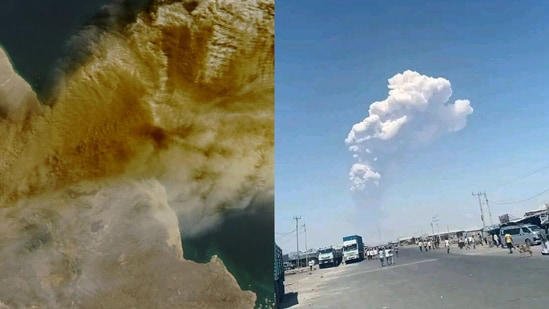
On Monday night, residents in Delhi and surrounding regions saw something unusual: a hazy brown-gray layer drifting silently above the city. At first, many assumed it was pollution a familiar reality in late November when smog, crop burning residues, and winter air inversions choke northern India. But this time, a different phenomenon was at play. A long-dormant volcano, Hayli Gubbi, thousands of kilometers away, had erupted in Ethiopia. And its ash cloud was now traveling through high-altitude wind corridors drifting into the Indian subcontinent.
It felt unreal. How could a volcanic eruption from the Horn of Africa affect New Delhi, Rajasthan, Maharashtra, or even the Himalayas? But the science behind atmospheric circulation leaves no room for disbelief. All it needs is enough altitude, the right winds, and time.
In this blog post, we explore how this ash arrived, how long it is expected to linger in Delhi, which regions are most affected, and what it means for aviation, public health, and future climate events. Most importantly, we unpack why atmospheric disruptions in one part of the world can no longer be dismissed as far-away events.
The Rare Awakening of a Sleeping Volcano
The Hayli Gubbi volcano, situated in Ethiopia’s Afar region, is not a household name like Mount Etna or Mount St. Helens. It is one of the many lesser-known fissure systems that define the East African Rift a region geologists often call “Earth’s largest tectonic experiment in real time.” This rift is gradually pulling apart the African continent, creating fractures that allow magma to rise to the surface.
When Hayli Gubbi erupted, it did so violently, releasing a towering column of ash. Some meteorological models estimated that the plume climbed close to 45,000 feet higher than most commercial aircraft fly. Such eruptions release more than smoke. They eject pulverized volcanic rock, aerosols, glass-like particles, sulphur dioxide, and mineral dust into the sky. Unlike smoke from fires, volcanic ash does not disperse quickly. It is abrasive, heavy, and physically harmful to engines, aircraft sensors, and even human lungs.
In the early hours after the eruption, satellite images showed the plume traveling west across the Red Sea into Yemen and Oman. The cloud didn’t behave like a casual breeze; it moved swiftly, guided by high-level jet streams. Within hours, it crossed the Arabian Sea a journey that would normally take weeks if it were grounded dust or urban smog.
What Ash Did When It Reached India
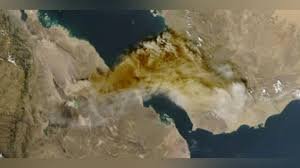 Late Monday evening, around 11 PM, the ash entered the Indian atmospheric zone. It was almost eerily stealthy invisible to most lay observers. People in Delhi went to sleep under a familiar winter haze. But meteorologists and aviation agencies throughout India were already tracking the plume.
It wasn’t just Delhi. Forecast models showed the cloud sweeping across:
-
Rajasthan
-
Gujarat
-
Punjab
-
Haryana
-
Delhi-NCR
-
Western Maharashtra
-
Himalayan foothills and the Terai belt in Uttar Pradesh
The movement was alarming because this wasn’t urban pollution, pollen, or sand from the Thar. It was sharp volcanic particulate matter abrasive, heat-resistant, and electrically conductive. Unlike PM2.5 pollution in cities, volcanic debris can damage aircraft windows, clog turbine blades, contaminate electronics, and erode metal.
Meteorological observers estimated the ash was moving at speeds of 100–120 km/h far quicker than typical dust clouds. And in some regions, the ash layer was sitting high up between 15,000 and 25,000 feet, occasionally rising toward 45,000 feet, similar to its origin altitude.
“How Long Will It Stay?” The Question Everybody Asked
As the news spread across social media and news platforms, one question surfaced everywhere: When does it leave?
India Meteorological Department (IMD) Director General Mrutyunjay Mohapatra offered the first reassuring timeline. He explained that the ash plume would leave Indian airspace by around 14:00 GMT roughly 7:30 PM IST on Tuesday. The trajectory beyond India pointed towards western China, pushed further northeast by high-altitude winds.
This forecast was not a guess. It was based on satellite images, dispersion modeling, and real-time data shared by international Volcanic Ash Advisory Centers agencies specifically built to track airborne volcanic hazards. These units inform pilots, air force controllers, and global flight operations so that aircraft avoid dangerous altitudes.
Meteorologists stressed that what India experienced was a pass-through, not a stagnating blanket. There was no expectation of ash “settling” on Delhi rooftops or coating farmland. For the most part, the plume’s concentration remained high in the atmosphere rather than descending into breathing zones.
Why Volcanic Ash Is a Nightmare for Airlines
Even though the ash cloud was several kilometers above ground, aviation authorities acted instantly. India’s civil aviation regulator, DGCA, issued an advisory warning airlines of visibility disruption, engine hazards, and equipment erosion.
Commercial airlines responded the way aviation always does: cautiously and conservatively. Some flights were rerouted. Others were canceled altogether. Akasa Air canceled flights to and from Kuwait, Jeddah, and Abu Dhabi on November 24 and 25 because of ash-related uncertainties.
This may sound dramatic, but aviation history has taught painful lessons:
-
In 1982, British Airways Flight 9 flew into volcanic ash and its four engines shut down mid-air.
-
In 2010, ash from Iceland’s Eyjafjallajökull catastrophe grounded nearly all of Europe’s air traffic for six days.
-
In 1989, a KLM flight lost power in Alaska after ash entered the turbines.
Jet engines superheat air to over 1,200°C temperatures that turn volcanic ash into molten glass. This melted residue can coat engine components, destroy sensors, and even freeze turbines mid-flight. Volcanic ash also disrupts radar, pitot tubes, GPS signals, and fuel flow.
So when the DGCA sounded an alert, no airline waited for confirmation. They simply acted.
Why Delhi Felt Normal But Still Wasn’t
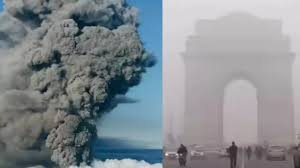
Interestingly, the average person in Delhi did not feel anything dramatically different. No volcanic smell. No shifting colors in the sky. No ash snowflakes drifting down.
One reason is altitude: the ash was high in the troposphere and lower stratosphere. It wasn’t mixing with city-level pollution or street-level smog. If the plume had descended into 2,000–4,000 feet atmospheric layers, the effects would have been drastically visible and dangerous to respiratory health.
This raises another important point: volcanic ash is not a PM2.5 “pollutant” that government agencies measure with standard air quality sensors. Many sensors simply do not detect it. So AQI numbers did not spike because of the ash. They were already high due to urban pollution.
To an uninformed observer, Delhi felt “normal” which is to say, typically polluted. But that normalcy masked an unusual layer moving above commercial air corridors.
The Scientific Journey: From Ethiopia to Northern India
 The geography of this ash event almost reads like a textbook example.
-
The eruption occurred in the Afar Rift.
Hot magma rose rapidly, carrying ash into the upper atmosphere. -
High-altitude winds carried it westward.
The Red Sea becomes a tunnel when upper winds accelerate. -
The plume moved toward Yemen and Oman.
These areas are climatologically linked to jet stream pathways. -
Then came the Arabian Sea.
At certain altitudes, Arabia to India is a straight-line corridor. -
The cloud entered the Indian skyspace.
Airflow pushed it across North and West India. -
Finally, models showed its exit over the Himalayas.
Propulsion by jet streams drew it toward western China.
This path of Delhi illustrates the globalization of atmospheric behavior. The same winds that carry Saharan dust to the Amazon forests or California wildfire smoke to Europe are merely following physics.
Indian Authorities Had No Time to Hesitate
One thing the public rarely sees is how fast meteorological agencies move when volcanic ash is involved. It is not like a weather forecast predicting rainfall next week. A single miscalculation can cost lives.
The IMD worked with satellite imagery, weather radars, and international data channels. Met Watch offices in New Delhi, Mumbai, and Kolkata stayed on alert around the clock. Their job wasn’t just to track the ash. It was to issue advisories that airlines, airports, cargo carriers, and military airbases rely on.
Even space agencies keep an eye on such events. High concentration ash clouds can interfere with near-Earth satellite readings and damage sensitive instruments. The Indian Air Force also monitors these movements because its aircraft unlike passenger jets may need to fly emergency or mission routes regardless of atmospheric disruptions.
What Happens After the Ash Leaves?
The fact that the plume left India on Tuesday evening does not mean the story is finished. The material will drift into Central Asia and potentially disperse into the mid-latitude jet stream network. Some components may circle the globe at high altitudes over several weeks.
In some volcanic events, sulphur dioxide oxidizes into sulfate aerosols microscopic crystals that reflect sunlight and temporarily cool global temperatures. Major eruptions like Pinatubo in 1991 lowered Earth’s temperature by nearly 0.5°C for almost two years.
Hayli Gubbi is not Pinatubo. But the eruption is a reminder that local climate change depends heavily on global atmospheric processes. A monsoon disruption in Southeast Asia or crop pattern changes in Africa can trace roots to volcanic activity 10,000 km away.
A Wake-Up Call
The ash did not fill in Delhi streets or darken in Delhi skies, but it carried a message: the climate world is more interconnected than we like to admit. Weather events, tectonic movements, and high-altitude winds are no longer “regional news.” They are chain reactions in a global web.
When a dormant volcano in Ethiopia wakes up, airports in India cancel flights. When a dust storm in Sahara intensifies, rainfall patterns in Brazil shift. And when high-altitude winds carry volcanic particles across continents, the average person in Delhi wakes up and checks AQI apps without realizing a 45,000-foot atmospheric traveler passed overhead.
The volcanic ash over India was a transient visitor. It arrived suddenly, moved quickly, and left within roughly 24 hours. But its existence should change how we think about airspace, weather alerts, and environmental safety.
Here’s the takeaway in simple terms:
-
Delhi and northern India weren’t in danger of ash “settling” or suffocating streets.
-
The real threat was to aviation, satellites, and the integrity of aircraft engines.
-
The ash has now moved toward western China, carried by upper wind systems.
-
India’s response was swift and precautionary exactly the way it needed to be.
As Delhi climate volatility grows, so will the frequency of cross-continental weather interactions. The Hayli Gubbi event was not catastrophic but it was a strong reminder that Earth is never local. What erupts in Ethiopia can ripple through Delhi, and what we breathe or fly through can be shaped by forces far beyond our imagination.To know more Subscribe jatininfo.in now.