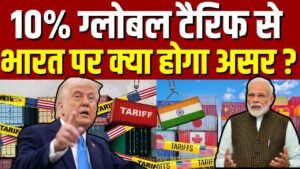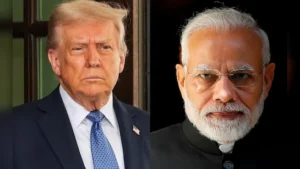
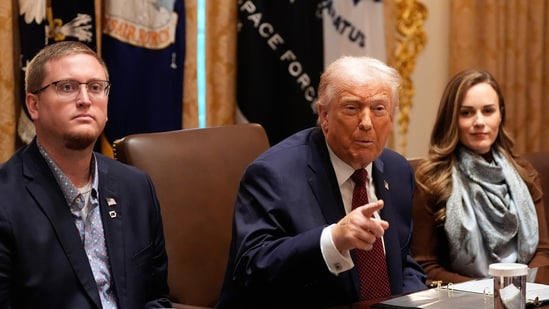
When Donald Trump talks trade, even a passing remark can shake up an entire industry. That’s exactly what happened this week after he casually floated the idea of tariffs on Indian rice during a White House meeting with U.S. farmers. What looked like an ordinary roundtable quickly turned into a mini-controversy, with India unexpectedly dragged into the spotlight.
Trump had gathered farmers to announce a hefty $12 billion support package. Instead of just celebrating the aid, he ended up questioning why countries like India, Thailand and even China were allowed to “dump” rice into the American market.
The spark came from Meryl Kennedy a well-known figure in the U.S. rice world who told Trump that cheap imports were hurting local growers. That was all he needed.
“Why is India allowed to do that?” he asked Treasury Secretary Scott Bessent, interrupting him before he could even finish his reply.
Trump didn’t mince words either. “They shouldn’t be dumping. You can’t do that.”
By the end of the meeting, Trump had made it clear that he planned to “take care” of the problem.
And just like that, one sentence turned a quiet trade issue into an international headline.
Why American Farmers Are So Worked Up
To understand why Trump reacted the way he did, you have to look at the pressure U.S. farmers are facing right now. Costs are up across the board fertilizer, diesel, transport, everything and many feel overwhelmed by cheaper foreign competition. Rice farmers, especially in states like Louisiana, Arkansas and Mississippi, say they simply can’t compete with Asian suppliers. Indian rice, in particular, is often significantly cheaper. Some of it is due to lower labor costs. Some of it is because India supports its farmers heavily. But to an American grower watching prices fall, the reason doesn’t matter. What matters is that they’re losing. For Trump, who relies on rural voters more than most politicians, this is a sensitive topic. Being seen as defending them is always politically useful.
Why India Is Suddenly in the Crosshairs
India is not just any rice exporter it’s the biggest in the world, supplying nearly 40% of global rice exports.
The U.S. doesn’t import huge volumes compared to countries in Africa or the Middle East, but the imports it does allow have an outsized effect on prices. Low-cost basmati and parboiled rice from Indian exporters can undercut American growers by a decent margin.
India, meanwhile, insists it isn’t doing anything wrong. Lower prices, they argue, come from efficiency and scale not a scheme to flood foreign markets. But trade isn’t always about data. Sometimes perception is enough to set off alarms.
And with Indo-U.S. trade negotiations already stuck, the timing of Trump’s comments couldn’t have been worse.
A Second Tariff Threat This Time at Canada
Interestingly, India wasn’t the only country Trump took a swipe at. In the same meeting, he hinted at possible tariffs on Canadian fertilizer, saying the U.S. should produce more locally instead of relying on imports.
This fits into the bigger pattern of Trump’s economic outlook:
-
Make more in America
-
Reduce reliance on trading partners
-
Use tariffs as a blunt tool to force compliance
It’s a style that appeals to his base, but it often complicates diplomatic relations.
Why This Escalates So Quickly
The tricky part is that the U.S. and India are in the middle of a tense but important phase of their relationship. Both countries have had a rough stretch on trade:
-
Earlier this year, Trump raised tariffs on Indian goods to 50%
-
Talks have dragged on without progress
-
A U.S. delegation is landing in India shortly
-
No breakthrough is expected
Now add a new tariff threat on something as sensitive as agriculture and the atmosphere becomes even more complicated.
Even a simple off-the-cuff comment can change the tone of negotiations.
Is India Really “Dumping”?
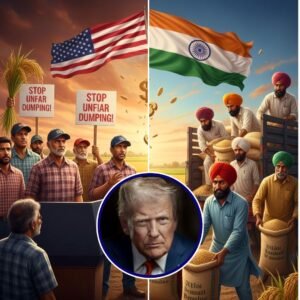 Dumping is a very specific accusation selling products abroad at artificially low prices. The U.S. rice industry says that is exactly what India is doing. India says the accusation is unfair and politically motivated.
Here’s what’s actually true:
-
India has extremely low production costs
-
Government programmes do help farmers, but not always in export markets
-
India sells rice based on its massive scale and strong milling ecosystem
-
Many countries buy Indian rice because it is reliable, not because it is suspiciously cheap
But Trump’s comments were framed not as an economic analysis, but as a political stance and in politics, perception often wins over nuance.
What Happens If Trump Actually Imposes a Tariff?
If the U.S. goes ahead, a few things are almost certain:
1. American rice prices will go up
Imported rice is usually cheaper. Less of it means costlier options in supermarkets and restaurants.
2. Indian exporters will take a hit
The U.S. is not their biggest market, but losing access to any wealthy economy hurts.
3. India may retaliate quietly
Maybe not with headlines, but through slower approvals, subtle restrictions, or changes in import rules.
4. Trade talks will get even messier
India doesn’t like being singled out in public.
5. Global rice markets could wobble
India is too dominant for disruptions to go unnoticed.
The Political Angle Nobody Is Saying Out Loud
This is an election year conversation disguised as a trade issue.
Trump’s comments:
-
Make farmers feel heard
-
Show he is “tough” on foreign producers
-
Reinforce his long-standing narrative that America gets a “bad deal”
-
Give him a reason to talk about tariffs a topic he enjoys
-
Put pressure on the Biden administration or his own advisors depending on timing
In short, it’s not just about rice. It’s about politics.
India’s Possible Response Likely Measured, Not Aggressive
India rarely escalates these situations dramatically. Expect a controlled response:
- Diplomatic quiet channels
- Data-driven rebuttals
- Mention of India’s own market barriers (like dairy or medical devices)
- Emphasis on broader Indo-U.S. cooperation
India knows the relationship goes far beyond one commodity. But it also cannot ignore a public allegation from Trump, especially one that affects millions of Indian farmers and exporters.
Why Consumers Should Care About This
If you’re in the U.S., here’s what this could mean:
-
Basmati and speciality rice could cost more
-
Restaurants relying on imported rice may raise prices
-
Grocery stores may face shortages for a few weeks
-
Domestic rice might become the default option
In India:
-
Exporters may scramble for clarity
-
Farmers may worry about price stability
-
Domestic markets may fluctuate a little
This is not a small story it affects kitchen shelves and farmers on two continents.
Is Trump Serious or Just Testing the Waters?
 With Trump, there are two phases to every trade threat:
1. Talk about tariffs loudly
2. Use the threat as leverage in negotiations
He did this with:
-
China
-
Europe
-
Mexico
-
Canada
-
India before
Sometimes he follows through. Sometimes he doesn’t.
Right now, this feels like an opening move, not a final decision. But that doesn’t make it harmless.
Markets and governments react even to the possibility.
A Simple Question, a Complicated Fallout
Trump’s remark “Why is India allowed to do that?” may sound like casual frustration, but it touches on deeper issues:
-
Farmer anxiety in the U.S.
-
India’s global rice dominance
-
Stalled trade talks
-
Trump’s protectionist style
-
Domestic politics disguised as policy
Whether or not tariffs actually appear, the conversation has already shifted. India will have to navigate another delicate chapter in its trade relations with Washington, and American farmers will watch closely to see whether Trump’s tough talk turns into action. Sometimes, a single sentence from a former president is enough to set two economies on edge. To know more subscribe Jatininfo.in now.