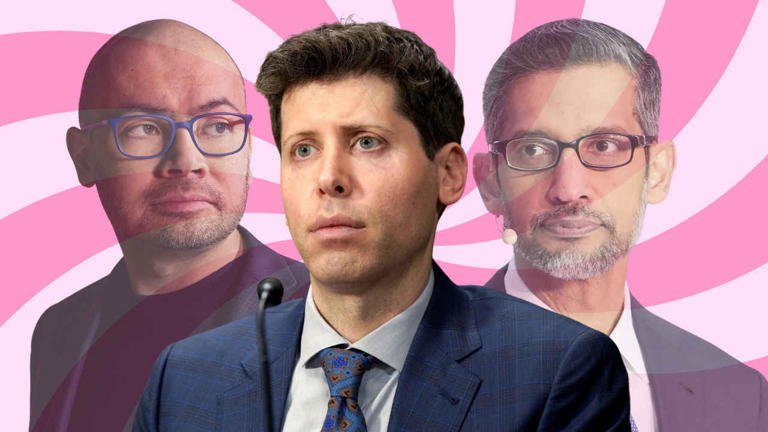
For more than a decade, Silicon Valley has been fueled by competition Apple vs Android, Facebook vs TikTok, Amazon vs Walmart. But the rivalry shaping the future of technology today is on a different level entirely: OpenAI vs Google. The battleground isn’t search engines or smartphones. It’s something far more fundamental how humanity will think, work, and make decisions in the age of artificial intelligence.
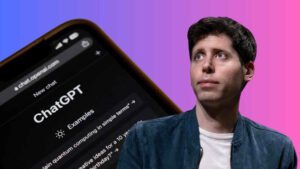
What makes this rivalry fascinating is not simply the math behind neural networks or the number of GPUs in data centers. The real drama lies in the leadership philosophies behind each company. Sam Altman, the unapologetically ambitious CEO of OpenAI, has publicly acknowledged a fear: ChatGPT, the AI model that reshaped public consciousness, might be losing momentum. And the competitor threatening to eclipse it is Google the very company OpenAI once sought to disrupt.
To understand why Altman is suddenly wary, we need to rewind the clock, unpack how each company views AI, and explore how the next era of intelligent systems has turned into a race of survival.
How OpenAI Became the “People’s AI”
When ChatGPT launched in late 2022, it felt magical. A chatbot that could write poems, debug code, summarize books, and even help students complete homework it redefined what “software” could do. AI was no longer an abstract lab experiment. It sat in your browser.
For many people, OpenAI was the first “face” of artificial intelligence. Engineers, teachers, freelancers, parents everyone suddenly had a digital assistant. The company began to carry mythological branding: bold, young, slightly rebellious. The Silicon Valley startup that dared to do what giants were afraid to attempt.
That narrative worked. For months, Google looked slow, hesitant, and almost confused. Its leadership had spent years warning employees not to “ship experiments.” OpenAI meanwhile pushed boundaries, sometimes recklessly. Their message to the world was clear: Move fast. Build the future. Take risks.
But momentum is a fragile ally. And as the dust settled, OpenAI realized something uncomfortable: the race hadn’t truly begun yet.
 Google may have seemed quiet during the ChatGPT explosion, but that quiet was deeply misleading. AI research has been baked into Google’s DNA since its earliest years. PageRank is a kind of proto-AI. Gmail filters spam using machine learning. YouTube recommends videos using neural models. They were experimenting with transformers long before the public heard the word.
For years, the company was cautious because it feared backlash. An AI that generates nonsense, misinformation, or dangerous instructions is a nightmare for a brand associated with billions of users. So instead of releasing things, Google hoarded knowledge.
When OpenAI broke that dam, Google realized restraint was no longer an option. The result: Gemini, DeepMind breakthroughs, agentic models, reasoning-focused systems, and a sudden shift in tone. The company stopped asking “Is it safe to release?” and began asking “Can we afford to be last?”
That single shift flipped the dynamic. OpenAI was no longer the pioneer disrupting the giant. It was the smaller company being chased by a beast with infinite money, cloud dominance, and data pipelines into every smartphone on Earth.
Sam Altman’s Worry: The Loss of Cultural Momentum
Sam Altman is not someone who easily admits vulnerability. He speaks like a founder who believes destiny is negotiable. So when he hints that ChatGPT may be losing ground, people notice. He isn’t afraid of Google’s brand or its search empire. He’s afraid of time specifically, how quickly the public forgets who invented something first. When ChatGPT exploded, it was not the smartest model in the world it was simply the first one to reach everyone’s hands. The name “ChatGPT” became synonymous with generative AI. That branding advantage was priceless. But if Google begins building systems that reason better, offer real-time answers, or integrate with search, calendars, emails, and documents, OpenAI becomes just another vendor. Not the AI revolution just a contributor to it.
Altman understands a basic rule of technology:
People don’t remember innovation. They remember who gives it to them.
Apple didn’t invent smartphones. Netflix didn’t invent streaming. Tesla didn’t invent electric cars. They owned narratives. If Google can deliver AI in a way that is frictionless and woven into daily life, OpenAI becomes the MySpace of AI famous, loved, but ultimately overtaken.
ChatGPT Is a Destination, Google Is an Ecosystem
 OpenAI’s biggest strength is conversational intelligence. ChatGPT is fundamentally a place you go there to talk to AI. Google’s strength is the opposite: you don’t go anywhere at all. Google is already everywhere you live digitally.
-
Gmail
-
Docs
-
Android
-
Maps
-
Photos
-
YouTube
-
Chrome
-
Search
AI embedded into those systems becomes invisible. Not a chatbot. A life lubricant.
Imagine Gemini quietly optimizing your meeting schedule, or rewriting documents on the fly, or summarizing inbox chaos with one click. Imagine an AI system that works in the background of billions of devices, not because you asked it to, but because it already has access. OpenAI can’t force itself onto your phone or into your operating system. Google can do it overnight. That’s the fear Sam Altman doesn’t spell out, but it hangs above every OpenAI product meeting.
Research Philosophy: Two Meanings of Intelligence
OpenAI and Google do not answer the same question when they build AI.
-
OpenAI’s North Star:
Make a system that can reason like a human and eventually exceed us. -
Google’s North Star:
Make systems that solve tasks reliably at industrial scale.
One cares about cognition. One cares about automation. And this difference matters. OpenAI pushes deep reasoning, agentic planning, multimodal understanding, small-context creativity. It releases models that can write novels or talk like a friend at 2 AM. Its vision is emotional and philosophical. It imagines collaboration between minds. Google’s approach is colder and in many ways, more dangerous. It wants AI that can do work.
Not worksheets.
Not bedtime poems.
Not image prompts for fun.
Work.
Logistics optimization.
Protein folding.
Medical prediction.
Search replacement.
Coding pipelines.
Robotics.
Tasks tied to economics, not user entertainment. OpenAI’s products often feel like personal assistants. Google’s feel like replacements. Sam Altman doesn’t fear Google because they’re smarter. He fears them because they think like an empire.
The Catalyst: Money Is Changing the Game
Artificial intelligence isn’t like mobile apps or web startups. You don’t create a billion-dollar AI company in a garage. Model training requires computing power that burns electricity at the rate of small countries. OpenAI is funded by investors yes, even Microsoft, despite the partnership, has expectations. Google runs its own hardware, custom Tensor chips, TPU pods, and integrated cloud architecture. That creates a fundamental asymmetry:
OpenAI experiments.
Google industrializes.
When Altman worries about losing the race, he isn’t worried about public opinion. He’s thinking about the economics of scale. If Google can train twice as fast, deploy models across Android, and push updates to Gmail users instantly, then OpenAI becomes the scrappy outsider again.
The public sees “AI companies.” Silicon Valley insiders see “GPU consumption battles.” Whoever controls compute supply controls future intelligence.
ChatGPT’s Identity Crisis
 The success of ChatGPT created an unexpected side effect: everyone thinks OpenAI is the chatbot company. That’s unfair to their research teams, but the perception matters. The broader community now asks OpenAI:
-
“What’s the next GPT?”
-
“How will the chatbot get smarter?”
-
“When is the new model coming?”
Meanwhile, Google isn’t being asked anything. They simply roll out projects. Speech translation inside Android. Reasoning agents for medical research. AI copilots for corporate search suites. Large-scale planning models for mapping. If OpenAI stays branded as “the chat company,” the ceiling becomes rigid. Altman knows what happened to BlackBerry. Brilliant invention. Stuck in one product category. Killed by a platform.
Who Actually Wins?
The uncomfortable truth is this: neither company is truly ahead yet. OpenAI leads in cultural imprint and conversational experience. Google leads in infrastructure, distribution, and deep industrial research. The real victor will be whichever company translates intelligence into daily life. And here is where the race gets philosophical.
If intelligence becomes a commodity like electricity platform advantage matters more than cleverness. The best model doesn’t win. The easiest one does. Google’s AI might not be poetic. ChatGPT might not integrate deeply. But whoever crosses both domains first emotion plus utility will own the world.
The Human Element: Fear Is Not Weakness
Sam Altman’s fear isn’t a retreat. It’s strategy. Every meaningful breakthrough in technology begins with discomfort:
-
IBM feared losing mainframes to personal computers.
-
Intel feared ARM taking over mobile.
-
Adobe feared browser dominance.
Fear forces adaptation. Fear accelerates innovation.
Altman’s unease signals that OpenAI is entering its second phase not the “hero startup” era, but the “war mode” era. The period where survival matters more than admiration. The question is not whether ChatGPT is losing. The real question is:
Will OpenAI reinvent itself again before Google locks the gates?
The AI race today is not about who has the smartest chatbot. It’s a struggle over how humans will interact with knowledge, creation, and decision-making for the next century. OpenAI gave the world a taste of AI’s potential. Google wants to control its infrastructure. One inspires. The other embeds. If Sam Altman is worried, it’s because he sees that the public narrative is shifting. Being first is different from being forever. Momentum can evaporate, and companies with deep pockets have long memories. But history offers a twist: Google once looked unstoppable. Then a scrappy startup called OpenAI made the world fall in love with a chat window. This race isn’t over. It hasn’t even reached the real track. To know more subscribe Jatininfo.in now.