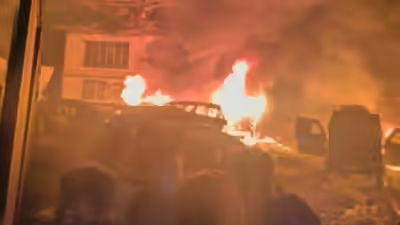
On a quiet Friday night in Srinagar Nowgam police station, tragedy struck in a way far more chilling than the usual headlines from Jammu & Kashmir. At around 11:20 pm, a powerful and catastrophic explosion ripped through the Nowgam Police Station, sending shockwaves literally across the valley. In the ensuing chaos, nine people lost their lives and more than 25 were injured, many critically, as authorities struggled to comprehend what had gone terribly wrong.
What appears, at first glance, to be an accident is now raising deeply uncomfortable questions not just about the handling of explosive material, but about how fragile the line is between law enforcement and catastrophe when dealing with the machinery of terror.
From Investigation to Nightmare: How Things Unraveled
To understand how the explosion happened, we must unwind the thread that led from a terror investigation in Faridabad to a devastating blast in Srinagar Nowgam police station.
The Terror Module Behind the Explosives
Earlier, security forces had uncovered what they have called a “white-collar” terror module a network involving highly educated professionals, including doctors. The probe had started in Nowgam itself, when threatening posters linked to Jaish-e-Mohammad appeared in mid-October. Meticulous CCTV analysis led to the arrest of three men with prior stone-pelting cases, and interrogation eventually revealed ties to a radical preacher.
The investigation soon led agencies to Faridabad, Haryana, where they raided a rented residence linked to one Dr. Muzammil Ahmad Ganaie, among others. In that raid, authorities recovered massive quantities of explosive precursor chemicals: ammonium nitrate, potassium nitrate, sulfur, wiring, remote control circuits, timers materials that could be used to build improvised explosive devices (IEDs). Reports suggest up to 360 kg of these explosive chemicals were seized. Much of that cache was then transported to Srinagar for forensic analysis.
The Nowgam Police Station, knowing that this was the site of the primary FIR (first information report) in the terror-module case, became the storage point for a considerable portion of the explosive.
The Moment of Horror: What Happened on That Fateful Night
 On the night of the blast, officials from the Nowgam police officer, forensic teams, and a magistrate were present. They were engaged in taking samples from the explosive material, according to authorities. In the process, something went deeply wrong.
Initial reports suggest that the massive pile of ammonium nitrate detonated. The force of the explosion was so intense that body parts were reportedly scattered as far as 300 feet from the station. The blast also triggered smaller, successive explosions, which made immediate rescue more dangerous and delayed the entry of bomb-disposal units.
CCTV footage, as per reports, captured the precise moment the structure was engulfed in fire and smoke a horrifying scene playing out in real time, leaving little room for denial that this was not a minor accident in Nowgam police station.
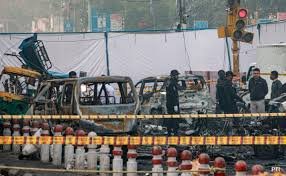
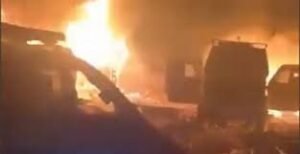
The destruction was severe. The building itself was badly damaged, vehicles within the compound were set ablaze, and rescuers scrambled to locate and evacuate victims amid ongoing danger.
Human Lives Lost and Shattered
By the early hours of Saturday, authorities confirmed in Nowgam police station blast nine fatalities. The identities of the deceased were not immediately disclosed, leaving their families and the region in shock and sorrow. Among the wounded were at least 27 people, primarily from the police force and forensic teams, along with a few civilians.
Some of those injured remain in critical condition, and as rescue operations wrapped up, the authorities shifted their immediate focus to medical care, identification of the deceased, and damage assessment.
Two Theories: Accident or Something More Sinister?
In the aftermath of the blast, officials have publicly acknowledged two possible triggers.
-
Accidental ignition: One line of investigation suggests that the ammonium nitrate may have ignited during the sealing and sampling process while officials (including a magistrate) looked on.
-
Deliberate act: Another angle being explored is more sinister that the blast might have been triggered by a rigged device. Reports mention a seized car parked inside the compound, raising speculation that it may have been booby-trapped with an IED. Some have pointed to a claim by a shadow militant group, though verification is ongoing.
Investigators now face a delicate balancing act: treating this as a tragic accident while also keeping open the possibility of foul play. The very materials that exploded were at the center of a terror investigation, after all.
The Bigger Picture: Failures, Risks, and Lessons
 This horrific blast is more than just a tragic accident. It shines a harsh light on deeper systemic vulnerabilities in how security agencies handle and store explosive materials, especially when such materials are linked to terror plots.
1. Safety Protocols Under Scrutiny
There are serious questions about whether best practices were followed. How was 360 kg of volatile chemicals stored within a Nowgam police station precinct? Were the personnel on-site properly trained for high-risk sampling? The successive mini-explosions suggest that volatile material may not have been fully stabilized or segregated.
2. Transport and Storage Risks
Transporting such a large quantity of explosive chemicals from Faridabad to Srinagar must have been an operation fraught with danger. The fact that so much of it was kept at the station raises questions about whether there were safer alternatives for example, a dedicated bomb vault or remote forensic facility.
3. Crisis Preparedness
The delay in rescue efforts because of follow-up blasts is deeply worrying. In a situation involving volatile unexploded material, a robust emergency protocol is essential. That the bomb-disposal squad was kept at bay suggests either a lack of preparedness or that risk assessments underestimated the danger.
4. Oversight and Accountability
Who approved this setup? Which senior officials reviewed the storage plan in Nowgam police station? In the face of such a catastrophe, these are not just technical questions they are moral ones. There will likely be a high-level probe into responsible decision-making and whether negligence played a role.
Human Cost: Beyond the Numbers
Behind every number in the casualty list is a human life a colleague, a family, a story now cut short. The forensic experts were not just “investigators”; they were the people who help make sense of terror. The police officers in Nowgam police station were not just “guards”; they were public servants putting their lives at risk.
For the survivors, this may be trauma that never fully heals: physical injuries, emotional scars, nightmares of the blast. For the families of those killed, the grief will be raw and relentless. And for the broader security establishment, there is now a burden of guilt, introspection, and the urgent need to rebuild trust.
What Comes Next: Investigations, Reforms, Reflection
In the days ahead, several critical steps must unfold:
-
A Full, Transparent Investigation
Authorities must leave no stone unturned. This includes forensic reconstruction of the blast, chemical analysis, chain-of-custody reviews, and testimony from everyone present during the sampling. -
Protocol Overhaul
Security forces and police will need to re-evaluate how they store dangerous materials. Are the current facilities and personnel adequate? Should there be more decentralized, specialized labs for handling large or volatile explosive hauls in Nowgam police station? -
Crisis and Risk Training
This incident underscores the need for advanced training of bomb squads, forensic teams, and local police in handling high-risk materials, dealing with secondary explosions, and conducting rescue in volatile environments. -
Compensation and Support
For the families of the deceased, and for the injured, immediate compensation, medical support, and psychological counseling are essential. Long-term care will be just as important Nowgam police station blast. -
Public Communication
Given the sensitivity both because of the terror-module link and public anxiety authorities must communicate openly and responsibly. Transparency about findings, reforms, and accountability will be crucial to restore trust.
The loss at Nowgam Police Station is a deeply tragic irony. The same explosives that were seized in the name of counter-terrorism ended up becoming the catalyst for a disaster within a secure compound. It is a grim reminder of how delicate and dangerous the tools we use to fight terror can become.
This is not a simple story of militants versus the state. It’s a warning about complacency, about overconfidence in procedure, and about what can happen when the very weapons you confiscate turn against you in a moment of human error or systems failure.
As Srinagar mourns, as investigators dig deeper, and as reforms are put into motion, the memory of the nine lives lost must serve as a catalyst for change. Not just for one police station, but for the entire system that handles the machinery of terror before it ends up being turned inward, with devastating effect. To know more about Nowgam case subscribe Jatininfo.in now.