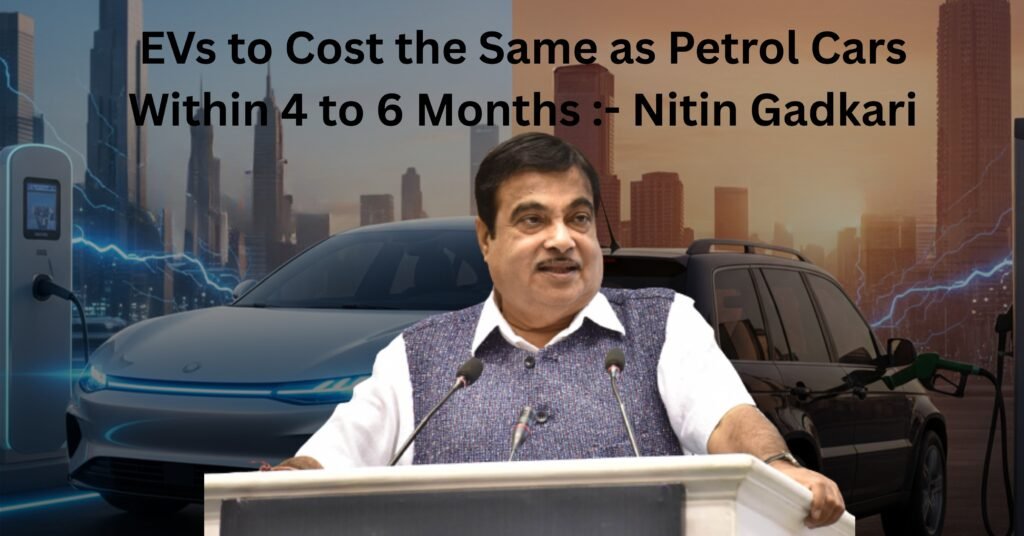
In recent remarks, India’s Union Road Transport and Highways Minister Nitin Gadkari has made a striking prediction: the prices of electric vehicles (EVs) in India are expected to reach parity with petrol-powered cars within the next four to six months. This announcement has drawn attention from auto-industry experts, environmentalists, prospective car buyers, and policymakers alike, because if realized, it would represent a major turning point in India’s push toward sustainable mobility.
This article explores what Gadkari has said, what underlies this forecast, what technical, policy, and economic forces are at work, what the implications might be, and what hurdles might need to be overcome for this promise to become real.
What Did Gadkari Say Exactly?
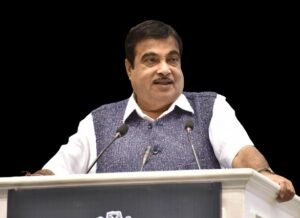 At the 20th FICCI Higher Education Summit 2025, Minister Gadkari laid out his vision for the auto sector. He stated that EVs will cost about the same as petrol vehicles within the next four to six months. He emphasized that India’s dependence on fossil fuels carries both an environmental cost and a heavy economic burden, pointing to the ₹22 lakh crore annual spend on fuel imports.
In addition, Gadkari spoke about broader goals: to make India’s automobile industry the number one globally within five years. He noted that when he took charge as Transport Minister, the industry size was roughly ₹14 lakh crore; it has since risen to ₹22 lakh crore. By comparison, the U.S. auto industry is valued at about ₹78 lakh crore, China’s at ₹47 lakh crore.
Gadkari also pointed out existing moves that support this change. Among them:
-
The recent reductions in GST (Goods & Services Tax) rates on certain vehicle categories. For example, small cars (under 4 meters) have seen GST reduced.
-
Policies that support indigenous manufacturing, reducing import burdens especially for EV components, batteries, and charging infrastructure.
-
Emphasis on clean, pollution-free mobility and green alternatives, which the government is pushing via incentives, infrastructure investment, and regulatory reforms.
What Are the Drivers Making This Possible?
Reaching price parity between EVs and petrol cars in such a short span is ambitious. There are a few key drivers or forces pushing in its favor:
 1. Battery Cost Reductions
The cost of EV batteries has been decreasing globally as technology advances, scale increases, and supply chains mature. Since batteries are among the costliest components in EV manufacturing, any significant reduction in battery prices translates to lower final vehicle costs.
2. Scale and Local Manufacturing
India has been pushing for domestic manufacturing of EVs, components, and batteries. “Make in India” style incentives, and policies that reduce dependency on imports, are helping reduce overheads, customs/import duties, and logistics costs. The growth of domestic supply chains can bring down input costs. Gadkari has highlighted the importance of import substitution and pushing for indigenous production.
3. Tax and Regulatory Incentives
Recent reductions in GST and removal of certain cesses on vehicle categories have already lowered costs for many petrol car models. These tax benefits also apply to EVs or have been shaped in favor of EV ambitions. Reduced taxes on EV components, subsidies, and favorable policies for charging infrastructure (like PM E-Drive scheme) are also helping.
4. Government Push and Policy Support
The Indian government is actively pushing for adoption of EVs: building EV charging infrastructure, offering incentives/subsidies for EV manufacturers, and taking regulatory steps to reduce the cost of procurement. Such policy moves reduce risk for automakers and can allow them to price EVs more aggressively.
Implications of Price Parity
If EVs indeed become as affordable as petrol cars within 4-6 months, several implications are likely, both positive and challenging.
Positive Impacts
-
Faster EV Adoption
Lower purchase price reduces a key barrier. Many prospective buyers are deterred by higher upfront costs of EVs compared to ICE (internal combustion engine) vehicles. Price parity could unlock a large latent market.
-
Reduced Fuel Import Bill
India spends enormous sums annually on importing crude oil and petroleum products. A shift toward EV usage means less spending and greater energy security. Gadkari’s ₹22 lakh crore figure annually for fuel imports underscores the scale.
-
Environmental Benefits
Less air pollution, reduced CO₂ emissions, and less reliance on fossil fuels. Cleaner urban air improves health outcomes, cost of pollution declines. EVs operate with zero tailpipe emissions, which helps India’s climate goals.
-
Growth in Automobile Industry
Lower costs and higher demand could lead to more production, more employment, and increased investment. Gadkari’s target to make India’s automobile sector world-leading might become more plausible with large scale EV adoption.
-
Boost for Supporting Industries
Battery manufacturing, charging infrastructure, renewable energy, software/hardware for EVs all will get a boost. This creates new jobs, new businesses, and innovation.
Potential Challenges & Risks
While the promise is exciting, achieving real parity is fraught with hurdles.
-
Battery Supply and Cost Volatility
Battery supply (lithium, cobalt, nickel, etc.) globally is limited and subject to price fluctuations. Import costs, shipping, and raw material constraints can push costs back up. If these aren’t managed, the promise could lag behind.
-
Infrastructure
Charging infrastructure (public and private) must be scaled rapidly. Consumers need confidence that charging stations are reliable, widespread, and fast enough. Without this, even price-competitive EVs may not see adoption rates surge.
-
Range Anxiety and Performance
Even if prices match, consumer perceptions about EVs range, charging times, battery life, resale value matter. If those are not addressed, many customers may still prefer petrol cars despite cost parity.
-
Production Scale and Quality
Automakers need to ramp up production at quality and scale. Quality control, safety standards, after-sales service and maintenance ecosystems for EVs are still developing in many parts of India.
-
Hidden Costs / Total Cost of Ownership
Beyond the purchase price, operating costs, battery replacement costs, electricity rates vs fuel costs, taxes, insurance etc., all play roles. If electricity is expensive, or battery replacement is costly, some EV models may still be more expensive over their lifetimes compared to petrol cars.
-
Price of ICE Vehicles
Parity could also happen if costs of petrol vehicles rise (due to taxes, fuel pricing, regulation), rather than EVs dropping solely. So comparisons may depend on what happens with petrol car costs and fuel/policy taxes.
What Are the Conditions That Must Be Fulfilled?
For this promise to be delivered, several conditions must be met:
-
Further reductions in battery and EV component costs, either via better technology, economies of scale, or favorable import/export policies.
-
Policy stability and incentives, including tax / GST reductions, subsidies, and support for charging infrastructure.
-
Manufacturing capacity growth domestically both for vehicles and components.
-
Boost in supply chains and logistics so that costs of parts, shipping, materials don’t eat up the savings.
-
Consumer confidence and awareness improvement, such that people are willing to consider EVs not just for environmental reasons but for economic benefits.
-
Electrification of more vehicle segments, including two-wheelers, three-wheelers, passenger cars, commercial petrol vehicles. More options improve affordability.
What Has Already Happened: Evidence and Early Moves
Some of the groundwork is already in motion:
-
GST Revisions: The government has recently reduced GST rates on small cars (under certain sizes) and made adjustments to the tax structure of petrol vehicles, which has helped reduce prices.
-
Price Cuts by Automakers: Companies like Maruti Suzuki, Tata, Mahindra, and Hyundai have announced price reductions on some petrol models up to lakhs (₹) in certain cases in response to tax changes. These provide a comparative baseline for EVs.
-
Subsidy Schemes and Support: Policy support, such as EV charging/ battery swapping station subsidies (e.g. PM E-Drive scheme) is helping reduce infrastructure cost and making the ecosystem more favorable to EV adoption.
What It Means for Buyers, Manufacturers, and the Market
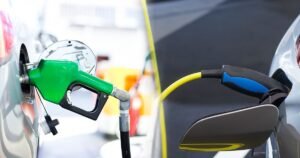 If EVs become price-competitive with petrol cars:
-
Consumers are likely to benefit from lower purchase costs, lower running costs (electricity tends to be cheaper than petrol per km), less maintenance, and possibly tax incentives.
-
Auto OEMs (Original Equipment Manufacturers) will need to adjust their product portfolios, invest more in EV models, battery technology, R&D, and supply chains.
-
Policymakers will need to ensure regulatory, tax, infrastructural, and incentive frameworks remain supportive and predictable.
-
Energy / Utility Sector will see increased demand for electricity, renewed urgency in grid readiness, renewable sourcing, and fast charging networks.
-
Used Car / Resale Market dynamics may shift; EV resale values depend on battery health, charging infrastructure, and total ownership cost.
Is the Timeline Realistic: 4 to 6 Months?
Gadkari’s estimate of 4–6 months to reach parity is ambitious. Some analysts believe that if current trends continue falling battery costs, favorable policies, reducing tax burden, local manufacturing it is possible for certain segments of EVs (especially small EVs or compact passenger EVs) to come close to parity.
But in many cases, full parity across petrol, diesel and all segments (SUVs, luxury models, long-range EVs) may take longer. The more expensive models will face component and battery cost constraints, and those will lag behind smaller, simpler EVs in reaching price equality.
Nitin Gadkari’s promise that EVs will cost the same as petrol cars within 4 to 6 months is bold and signals an aggressive shift in India’s electric vehicle policy and market expectations. If achieved, it could mark a major milestone in cleaner transport, reducing import bills, improving environmental outcomes, and transforming the automotive landscape in India.
However, it will require coordinated efforts across industry, government, and infrastructure. Falling battery costs, manufacturing scale, tax incentives, and consumer confidence will need to align. For many buyers, it could mean waiting for just a few more months before choosing an EV becomes not just an environmentally responsible choice but strictly an economically competitive one.
As the 4 to 6 month window unfolds, all eyes will be on automakers, battery manufacturers, consumer behavior, and policy execution to see whether this forecast becomes reality or remains aspirational. If you want to know more Subscribe Jatininfo.in now