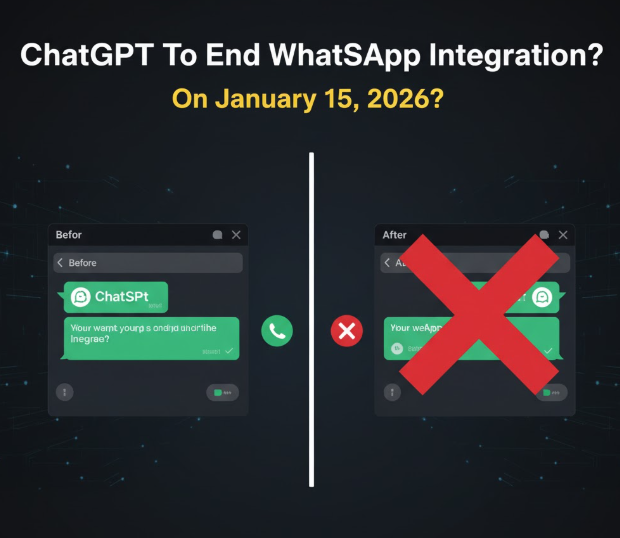
For the past year or so, something interesting has been happening in the world of messaging apps. People across India and many other countries started imagining a future where ChatGPT could live inside WhatsApp always available, always responsive, ready to help with anything from a simple reply to a complex business task. The idea felt almost too good: AI assistance inside the app we already use every day.
The excitement was never far from reality. Developers built early versions using ChatGPT’s API, and a few services tried to brand themselves as “official ChatGPT bots.” They weren’t official, but they proved one thing people wanted this badly.
Yet, despite the hype, there are now growing conversations suggesting that this dream might not unfold the way everyone expected. Some technology observers even believe the collaboration could quietly fade out sometime in early 2026. Not a dramatic shutdown more like a project that simply stops expanding.
So, what changed?
Why does a partnership that once looked obvious now seem uncertain?
Let’s break that down calmly and clearly without assumptions, without panic just facts, context, and what we can reasonably predict.
Why the Concept Was So Exciting in the First Place
 WhatsApp has more active users than any other messaging app, especially in India where it’s a core digital tool. ChatGPT, meanwhile, has shown how powerful language models can become answering questions, writing messages, creating translations, and so much more.
Put the two together and you get:
• Automated help for local businesses
• Students solving doubts instantly
• Support conversations that don’t require humans 24/7
• Voice + text input for multitasking users
• Faster messaging for elderly or disabled users
People felt WhatsApp would evolve from a communication tool into a smart digital companion.
And honestly, why wouldn’t Meta want that? Why wouldn’t OpenAI want that reach?
The enthusiasm was real until concerns arrived.
The Privacy Wall
WhatsApp makes a big deal about end-to-end encryption. It’s their promise — your messages stay private.
But AI doesn’t work in a sealed box. It needs some form of input access. And that triggers tough questions:
• How much data would AI see?
• Who processes that data Meta or OpenAI?
• Would conversations be stored and analyzed?
• Could governments ever trust this?
Different countries now have strong data protection laws. India’s Digital Personal Data Protection Act is one example. Regulations aren’t just guidelines — companies must obey them or face consequences.
That alone could slow any rollout.
Meta and OpenAI: Now Competitors Too
 Something big changed behind the scenes. Meta isn’t waiting for anyone anymore it’s building its own AI:
• Meta AI assistant already works in Instagram and Messenger
• Llama models keep improving fast
• AI search and image features are rolling out worldwide
So from Meta’s perspective, why not power WhatsApp with their AI instead of ChatGPT?
For OpenAI, that’s a direct strategic conflict.
What once looked like teamwork now feels more like two companies racing toward the same finish line.
Early Experiments Quietly Slowed Down
A few developers and business users who tested unofficial integration solutions have noticed something recently:
• Bots are being limited
• Fewer updates to WhatsApp automation
• API-based services under stricter scrutiny
It doesn’t seem like a project preparing for a massive global launch.
People in the industry now believe Meta may eventually tell businesses to rely only on approved AI tools most likely Meta AI itself.
Why Analysts Mention “Early 2026” as a Possible Turning Point
There is NO official announcement from OpenAI or Meta about shutting anything down on a fixed date.
But tech analysts often look at patterns, and right now the pattern suggests:
- Meta wants full in-house AI integration in WhatsApp
- OpenAI is busy building its own apps, voice tools, and browser experiences
- Regulatory pressure is going to get even tighter next year
So even without a dramatic press conference, a phase-out could simply happen gradually.
Who Would Feel the Impact First?
India
Because India is the heart of WhatsApp.
• More than 500 million Indian users
• Businesses run entirely through WhatsApp Business
• AI automation already saving countless hours per day
If ChatGPT-based tools get removed, even temporarily:
Small businesses lose instant response systems
Students lose their go-to homework help channel
Rural users who rarely use email or other apps lose access to AI
The shift would be noticeable.
But Why Would OpenAI Step Back?
One reason: risk.
Every major AI company right now is trying to prove it is responsible. OpenAI especially, after recognizing how easily misinformation can spread in private chat environments.
A single viral controversy involving WhatsApp could damage trust permanently. So a controlled, slower rollout is safer than a rushed one.
Experts generally see three possible paths:
- OpenAI and Meta eventually formalize a partnership
- Meta limits external AI bots and goes all-in with Meta AI
- Both companies co-exist competition drives innovation
All are possible. None are guaranteed.
Anyone claiming certainty today is guessing.
Should WhatsApp Users Be Worried?
Not really but being prepared helps.
Even if WhatsApp AI stops temporarily:
• ChatGPT apps are getting smarter every month
• Voice-based AI will become common in 2026
• AI operating systems may replace old app workflows completely
Messaging could become just one place where we interact with AI not the main one.
When the first ChatGPT bots appeared in WhatsApp, it felt like the future had arrived. But the future is rarely that straightforward.
Sometimes, progress means stopping for a moment.
Sometimes, innovation takes a different road.
ChatGPT might not grow inside WhatsApp the way people assumed and that’s okay. The smarter and safer rollout could lead to something better later.
What seems like a pause might actually be preparation.
What You Can Do Right Now
If WhatsApp-based AI is important for your work:
- Backup your automations
- Start experimenting with official ChatGPT mobile apps
- Keep an eye on Meta AI updates inside WhatsApp Business
Change is coming whether 2026 or earlier and adaptation is always the smartest move.
The story isn’t about whether ChatGPT leaves WhatsApp.
It’s about how we move toward a future where messaging and AI blend seamlessly without breaking trust, privacy, or security.
Whether the path continues straight or turns unexpectedly, the direction is clear:
- AI inside communication is not disappearing.
- It’s only evolving a little slower, perhaps, but much smarter.
To know more about new update subscribe Jatininfo.in now.