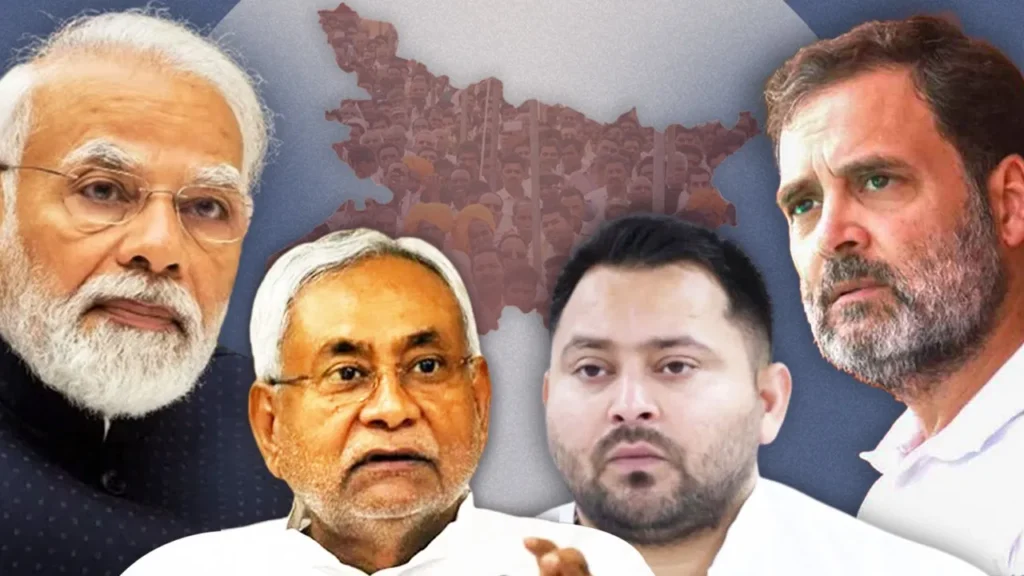
Bihar woke up to a tense morning on 14 November 2025. Long before the final tally, the state seemed suspended in a moment of decision citizens watching screens, news tickers flashing leads every few minutes, alliances announcing early victories, others cautioning against triumphalism. The stakes were high. The results of this election would not just decide power in the state’s 243-seat assembly but also carry implications for national politics.
In Bihar earlier trends had shown both the ruling National Democratic Alliance (NDA) and the opposition Mahagathbandhan (MGB) more or less side-by-side. Then, as of 10:45 a.m., a clearer picture started emerging: according to live updates from the Election Commission of India (ECI) and major media outlets, the NDA alliance was leading on about 161 seats, while the Mahagathbandhan was ahead on around 77 seats of Bihar.
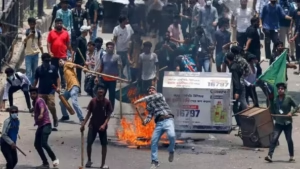
At the same time, the opposition was making noise. A senior leader in the Rashtriya Janata Dal (RJD) issued a warning that should their block not form the government, “unrest” may follow. Unrest of the kind seen in neighbouring regions, the claim went. The statement sent shock-waves, shifting the election conversation from ballots and leads to tension and public order.
Here’s a breakdown of what’s happening the numbers, the parties, the concerns, and what comes next in Bihar.
Why This Election Carried Immense Weight
Bihar isn’t just another Indian state. With over 100 million residents, it’s politically very significant. It sends 40 MPs to Parliament, and its local politics often mirror national trends.
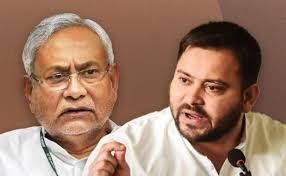
For the NDA led in the state by the Nitish Kumar-headed Janata Dal (United) (JD(U)) and the Bharatiya Janata Party (BJP) the goal was clear: secure a strong mandate, demonstrate sustained governance ability and silence critics of joblessness, migration and law-and-order issues.
For the Mahagathbandhan spearheaded by RJD and backed by the Indian National Congress (INC) this election was a chance of renewal: to challenge decades of incumbent rule, give a voice to the aggrieved, and build momentum ahead of future national elections.
Very few battles in Indian politics carry both local and national resonance like this one.
Latest Trends as of 10:45 a.m.
 By mid-morning, counting data painted a meaningful picture:
-
NDA leading on approximately 161 seats.
-
Mahagathbandhan trailing with around 77 seats.
-
The BJP (key NDA constituent) reportedly led in 70 seats or more.
These figures suggested the NDA was comfortably past the simple majority mark of 122 seats. At the same time, the gap between alliances remained fluid a handful of seats could still shift the entire trajectory.
The early lead injected confidence into NDA ranks and prompted caution, even urgency, in the opposition camp.
What Both Sides Are Saying
On one hand, NDA leaders were quick to highlight the early trendlines: their strategy, their welfare-first message, and their experienced leadership were being rewarded, they claimed. The mood among workers and supporters was upbeat.
On the flip side, Mahagathbandhan leaders stressed that these are early leads and nothing is decided yet. The RJD’s warning of unrest, however, upped the rhetoric significantly. It became not just about winning seats, but about what happens if the result doesn’t go your way. That shift from competition to caution underscores how high the political temperature has become in Bihar.
Key Factors Holding the Balance
 What exactly is making this contest so tight and unpredictable?
1. Youth and Migration
A large chunk of Bihar’s population is under 35. Many young people work outside the state or feel left behind in local employment. Their votes are no longer reliably traditional.
2. Welfare Versus Discontent
The NDA emphasised scheme delivery, roads, women’s pensions. The opposition emphasised joblessness, migration and local governance failures. Voters seemed split between the desire for stability and demand for change.
3. Caste and Community Dynamics
Long-standing patterns of caste allegiance still matter. But this year, cracks appeared: segments of backward castes, Dalits, and minorities appeared more volatile, less predictable.
4. Narrow Margins
Many seats in Bihar have historically been decided by margins under 5 percent of the vote. That means even small shifts matter. This is where the final few rounds of counting become crucial.
Why the Unrest Warning Adds a Dangerous Dimension
The RJD’s statement about unrest is more than rhetoric. In a state like Bihar where political conflict is often felt on the ground, the suggestion that result disappointment could lead to violence adds tangible risk.
It has three immediate consequences:
-
Heightened anxiety among voters and local officials.
-
Increased pressure on law-enforcement and Election Commission for rapid clarity and credibility.
-
Potential for protests or flare-ups if seat leads narrow further or appear contested.
When elections move from “who wins” to “what happens afterwards,” the democratic process itself comes under public deliberation.
What Happens If the Lead Holds and NDA Forms the Government
If the NDA crosses the majority mark cleanly:
-
A stable government can be formed quickly.
-
Nitish Kumar may become Chief Minister again, perhaps with renewed term.
-
The BJP will claim vindication of its dominance in eastern India.
-
Opposition will need to regroup, analyse where they lost ground and plan a comeback.
This outcome would strengthen the national narrative for the ruling alliance giving added momentum before key state elections and the next general election.
What Happens If the Contest Remains Tight or Opposition Gains?
Conversely, if the Mahagathbandhan narrows the gap or overturns expectations:
-
It will signal voter fatigue with the status quo.
-
Opposition unity may gain credibility and political currency.
-
It could destabilise the NDA’s home-terrain advantage.
-
Smaller parties will become kingmakers, opening complex coalition possibilities.
In a scenario of hung assembly or narrow results, governance in Bihar could face early challenges: deals, disputes, judicial scrutiny and delayed decisions.
What Voters and Citizens Should Watch Over the Day
-
Final seat tallies: Keeping an eye on which seats flip in the final rounds is critical.
-
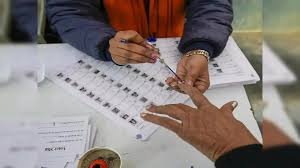
Turnout details: High turnout, especially in minority or youth-dominated areas, may indicate mood shifts.
-
Post-result reactions: Peaceful acceptance of outcomes is as important as who wins.
-
Use of mobile/e-media: Social media and instant messaging will shape public sentiment rapidly.
-
Transition speed: How swiftly a government is formed often reflects its strength and mandate.
The 2025 Bihar Assembly Election is thrilling for all the right and wrong reasons. It’s intense. It’s uncertain. It’s loaded with meaning. By 10:45 a.m., the trends strongly favoured the NDA, but with many seats still uncounted and shifting, the final story remains in suspense.
What’s clear, however, is that Bihar is not just voting for a government it’s voting for its future. The lead numbers matter. The speeches matter. The warnings matter. Most of all, the mandate matters because at the end of the day, for 130 million Indians in this state, what comes after the result will matter more than who crosses the line first.
The democracy show in Bihar is far from over. And in this photo-finish, every vote still counts. To know more update subscribe Jatininfo.in now.