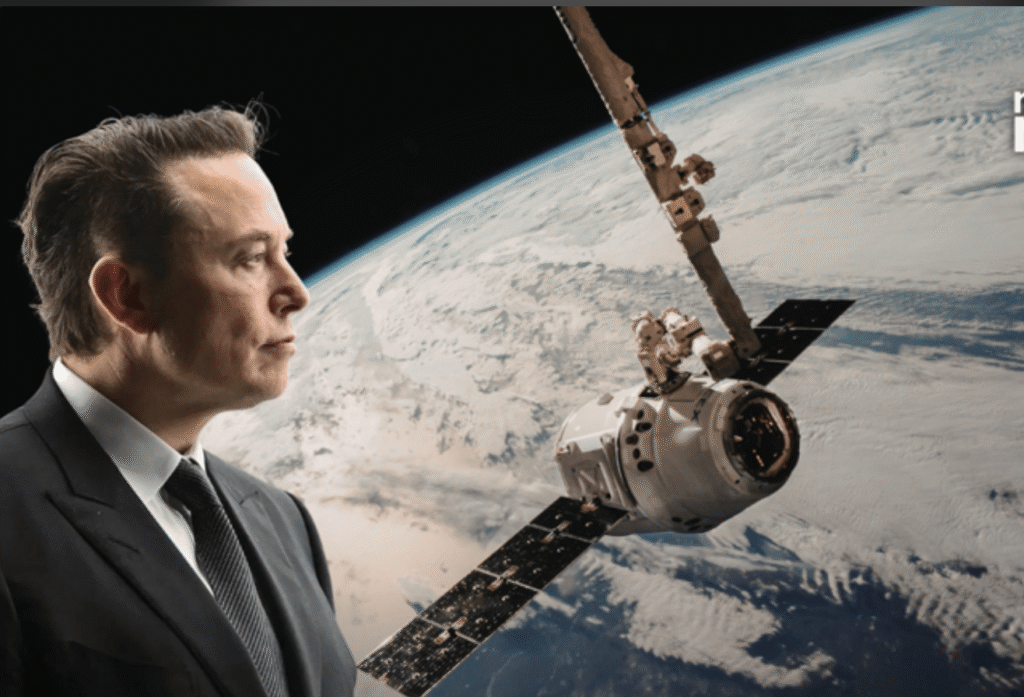
Every few months, Elon Musk drops an idea that sounds as if it has leaped straight out of a bold sci-fi novel. Sometimes it’s about colonizing Mars, sometimes about mind-machine interfaces, and sometimes about turning rockets into reusable taxis. This time, he has stitched together several of his favourite themes space, artificial intelligence, and industrial expansion into a single, sweeping vision: AI computation powered by space-based satellites, scaled eventually by factories on the Moon.
At first glance, it reads like something meant for a blockbuster movie script. But Musk has a pattern. Many concepts he shared years earlier, laughed at initially, later turned into real projects. The idea of landing and reusing rockets sounded insane in early 2010s. Today, it’s standard practice for SpaceX. So when Musk says something big, people listen even if with a mix of curiosity, skepticism, and awe.
In one of his recent posts on X, Musk laid out how space could become the next home for massive AI compute. Today, AI models devour unimaginable amounts of electricity. Running a single advanced model costs more power a day than some small towns. As AI demand explodes, so does the hunt for energy. Musk believes space offers the cleanest and most scalable supply we’ve ever had.
Why Musk Thinks AI Compute Will Move to Space
 Musk’s argument begins with a simple point: Earth-based resources especially energy are limited, expensive, and already under pressure. AI training runs require hundreds of thousands of GPUs running 24/7. The more advanced AI becomes, the more energy it demands.
Space, on the other hand, has two features that make it irresistible to an engineer who loves solving problems dramatically:
-
Sunlight with no interruptions.
Solar panels in low Earth orbit get nearly continuous sunshine. No weather, no fog, no night-time. Energy supply becomes stable, strong, and predictable. -
Plenty of room.
Earth-based data centers struggle with land, cooling systems, environmental regulations, and grid capacity. Space has none of that.
In Musk’s words:
“Satellites with localized AI compute… will be the lowest cost way to generate AI bitstreams in <3 years.”
It’s a bold prediction. But Musk says that instead of shipping raw data up and down, satellites could process data onboard and send back only the final results. This reduces bandwidth needs and turns space into a giant calculator. He suggests that manufacturing 1 megaton worth of satellites per year, each equipped with 100 kW of AI compute, could generate an unbelievable 100 GW of new AI processing per year without the typical electricity costs and maintenance burdens that Earth facilities face. Think of it as building a floating AI factory above our heads, powered by a star.
How Starlink Lasers Fit Into This Plan
Starlink already uses laser links between satellites, beaming internet data at high speed without relying on ground stations. Musk sees this laser network as the nervous system of a future space-based AI grid.
Here’s the flow he imagines:
-
Satellites in sun-synchronous orbits gather energy.
-
Onboard AI chips process data directly.
-
Results zip through high-bandwidth laser links across the Starlink constellation.
-
Users on Earth receive processed outputs, not raw data.
The idea is that satellite AI would complement Earth-based systems not replace them but would eventually become cheaper and easier to scale. If terrestrial AI infrastructure hits physical and economic limits, space-based AI computation bypasses those limits entirely.
A Step Toward Becoming a Type II Civilization?
Musk then invoked a concept rarely discussed outside astrophysics circles: the Kardashev Scale.
This scale measures how advanced a civilization is based on how much energy it can harness:
-
Type I: Uses all available energy on its planet.
-
Type II: Uses energy from its star.
-
Type III: Uses energy across its galaxy.
Humans aren’t even at Type I yet. We haven’t learned to use all the energy Earth provides. Musk’s idea of space-based AI powered by solar energy nudges humanity, even if only slightly, toward Type II using energy directly from the Sun at an industrial scale. It reframes AI growth not as a race for stronger GPUs or bigger server farms, but as part of a civilizational shift toward energy abundance. That’s not a small idea. That’s an idea that, if even partially realized, changes what we consider possible.
The Moon Factory Vision: A New Industrial Frontier
Just when the conversation seemed futuristic enough, Musk added another layer: building satellite factories on the Moon. Not metaphorically literally. In his expansion of the idea, Musk said:
“The level beyond that is constructing satellite factories on the Moon and using a mass driver to accelerate AI satellites to lunar escape velocity…”
Why the Moon?
The Moon has several advantages:
-
Lower gravity makes it easier to launch heavy objects.
-
No thick atmosphere means no air resistance.
-
Plenty of sunlight for solar power.
-
Huge space for industrial operations.
-
Rich raw materials, if mining becomes feasible.
If robotic factories can mine lunar regolith and turn it into satellite structures or components, human companies won’t need to ship as much hardware from Earth. That reduces costs dramatically.
What is a Mass Driver?
A mass driver is essentially an electromagnetic rail that can launch objects without using conventional rockets. Imagine a giant railgun that flings satellites into space.
With lower gravity, a lunar mass driver could send satellites into orbit incredibly cheaply.
Scaling to 100 Terawatts
Musk speculates this lunar industrial loop could eventually scale to more than 100 terawatts of AI power per year. To put that into perspective:
-
It is more energy than many countries produce annually.
-
It would dwarf every data center on Earth today.
-
It would turn the Moon into a self-sustaining AI manufacturing hub.
This isn’t just building more satellites. This is building a factory ecosystem beyond Earth.
A Currency-Free Industrial Ecosystem?
One of the strangest and most intriguing lines Musk shared was this:
“Once there are lunar factories, robots and mass drivers… the system probably decouples from conventional currencies and operates in watts and tonnage.”
That’s not just futuristic it’s almost philosophical.
He’s implying that once a system can extract its own energy, build its own machines, and launch its own products without Earth’s involvement, money becomes meaningless inside that system.
Value becomes measured in:
-
Energy output (watts)
-
Material production (tons)
In other words: economics without money a self-contained industrial mechanism.
If such an ecosystem someday exists, it would run autonomously, like a giant robotic organism powered directly by the Sun.
It’s an idea that challenges our entire understanding of economics.
How Close Are We to Any of This Becoming Real?
This is where the dream hits reality. Let’s break it down honestly.
Space-Based AI Satellites: Feasible in the Near Future
 This part is surprisingly realistic.
-
Satellites already carry processors.
-
Starlink already uses laser links.
-
AI models can run efficiently on specialized chips.
-
Solar power in orbit is mature technology.
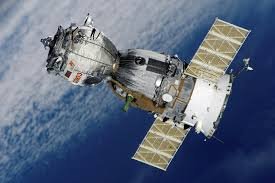
Companies could absolutely deploy satellites that run inference (AI answering tasks) instead of sending data back and forth. For some applications like real-time mapping, weather analysis, or Earth observation it might even be ideal.
Scaling it to thousands of satellites is expensive, but not impossible. SpaceX already builds satellites at a speed no one else comes close to.
Moon Factories: Still Science Fiction for Now
Building a full-scale industrial operation on the Moon requires:
-
Advanced robotics
-
Lunar mining capability
-
Automated construction systems
-
Reliable power infrastructure
-
Long-term habitation solutions
-
Stable lunar transport systems
Humanity is not there yet.
We haven’t mined a single gram of material on the Moon. We haven’t built machinery that can autonomously operate in lunar dust storms, extreme temperatures, and weeks-long nights.
But are we moving in that direction? Yes.
NASA’s Artemis program aims to return humans to the Moon. Several nations are planning rover missions. Private companies are developing lunar landers. The first steps are happening, albeit slowly.
What Musk’s Vision Really Represents
Whether Musk’s exact timeline or numbers pan out is less important than what this idea signals. This vision positions AI not as a tool sitting inside server rooms, but as a driver of human expansion into space.
AI becomes the reason we:
-
build factories on the Moon
-
create energy systems beyond Earth
-
develop autonomous construction
-
rethink economics
-
push towards becoming a Type II civilization
It’s an audacious narrative, but Musk has always used grand visions as motivation. SpaceX was never just a rocket company—it was a Mars settlement company that happened to build rockets to get there.
This new idea feels similar. Space-based AI may not be the final goal it is the bridge to a multi-planet future.
Ambition Today, Blueprint Tomorrow
Musk’s proposal may sound extravagant, maybe even unrealistic. Yet, history has shown that many technologies we take for granted today began as ideas people laughed at.
Reusable rockets. Private space stations. Electric cars outselling gasoline vehicles. Commercial satellite internet. All once unbelievable. All now real. That doesn’t mean lunar factories will appear next decade. Or that AI satellites will replace Earth data centers overnight. But it does mean the boundaries of possibility are shifting far faster than most people realize. If AI demand keeps growing the way it has, Musk’s space-based vision may not stay science fiction for long. We might actually live in a world where the sky above us is not just empty space, but a vast computing layer humming with intelligence powered directly by the Sun. And if lunar factories ever become a reality, it won’t just change technology it will change civilization itself. To know more subscribe Jatininfo.in now.