Social media platforms have always fought a difficult battle: should they show users everything in real time, or should they show only posts that are “worth” seeing? Twitter now X was once famous for its raw chronology. You followed someone, and you saw whatever they posted in the order it came. No algorithm, no filter. That simplicity was part of its appeal.
But Elon Musk’s X is no longer trying to be what Twitter once was. In late 2025, Musk announced a major change: the ‘Following’ feed will now be ranked by Grok, the in-house AI system built by xAI. The update promotes a new direction for X where generative intelligence decides what you see first, even when the content is coming from accounts you already follow.
According to Musk, Grok will sort posts from your Following list by engagement and relevance, not by timestamp. You can still switch back to chronological, but the default experience now attempts to think for you like a personal curator sitting inside your feed.
Some users love it. Some hate it. Many are unsure of what it means for digital communities. But there is no doubt: this move pushes social media into the next frontier where your interests, your habits, your reading patterns, and even your pauses will shape the feed in real time.
In this post, we explore why this move matters, how the feature works, its possible impact on creators and businesses, and what it says about the broader future of AI-powered social media.
What Exactly Changed: Grok Takes Over the Following Feed
To anyone who used the old Twitter, the Following tab was sacred. It was one of the few timelines left on the internet that wasn’t algorithmically sculpted. If you followed ten people, their posts appeared linearly whether they were popular or ignored, whether they got 5 likes or 5 million.
That model has now changed.
Grok, X’s proprietary AI engine, ranks what you see based on predicted engagement. In simple terms, the system tries to answer questions before you even think of them:
-
“Will this post grab your attention?”
-
“Will this creator spark your curiosity?”
-
“Are you the kind of user who reads more political content in the morning and entertainment in the evening?”
-
“Which posts will you linger on the longest?”
This is far removed from the legacy chronological feed. Instead of treating every post equally, Grok is now redistributing visibility based on patterns. It is a shift from objective order to subjective relevance an algorithmic filter that assumes it knows what you want.
For users who don’t like being told what to read first, X has kept a switch to return to classic chronological order. But the fact that chronological has become an optional setting not the default signals where Musk wants to take the platform.
Why Musk Did This: The Strategy Behind the Feature
To understand this update, we must first understand Musk’s broader vision for X. Since taking over Twitter, he has pursued a goal larger than a simple social network. Musk wants X to become an “everything app” a platform that integrates payments, shopping, media consumption, video streaming, and conversational AI.
To support that vision, the old Twitter model is too basic. One chronological list does not fuel a multi-layer digital economy. The businesses that thrive today TikTok, YouTube, Instagram are not chronological engines; they are predictive and recommendation-based.
Grok is X’s attempt to compete on that plane.
Musk knows that attention is currency. And AI-powered curation makes attention more predictable and therefore more profitable. A feed that shows users the most engaging content first can potentially:
-
Increase daily active usage
-
Improve retention
-
Boost advertisement efficiency
-
Help creators grow faster
-
Reduce bounce and churn
-
Encourage longer sessions
-
Feed more interaction signals back into the AI
Chronology is democratic, but it is inefficient. Algorithms are controlling, but they are powerful. Musk is betting that users will prefer a feed that feels tailored over a feed that feels raw.
AI as a Content Gatekeeper: Good or Bad?
Philosophically, Musk’s decision raises a crucial question:
Should an AI decide what people see?
When you follow someone, you’re expressing a clear preference. You’re choosing the voices and viewpoints you care about. From that point of view, Grok feels like an unnecessary middleman.
But from another perspective, following someone is not the same as wanting to see everything they ever publish. You might follow someone for tech insights, but they also post their brunch photos, memes, or emotional monologues. AI filtering might actually save you from noise.
There are also practical benefits. Consider a user who follows hundreds or thousands of accounts. A chronological feed becomes unusable in that context. The latest tweet may not be the most meaningful one. Grok’s ranking could surface posts you care about but might have otherwise scrolled past.
Still, concerns remain:
-
Echo chambers: AI may only show what aligns with your preferences, isolating you from contrasting viewpoints.
-
Manipulated engagement: Creators may optimize content for algorithmic triggers instead of authenticity.
-
Opacity: Users may not understand why certain posts appear or disappear.
-
Data dependency: AI needs behavioral data to train, inevitably raising privacy debates.
Whether Grok enhances or fragments digital discourse will depend not only on how it works, but on how transparently it evolves.
Grok’s Personality and Role in the X Ecosystem
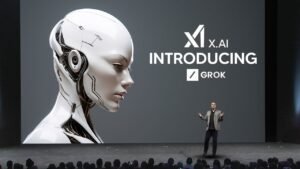 Unlike typical generative chatbots, Grok was developed from day one to be “rebellious,” humorous, and politically incorrect. Musk’s team trained it on real-time X data, meaning it reads, interprets, and interacts with content from the platform itself.
This makes Grok uniquely suited to social media ranking:
-
It understands trending signals
-
It knows cultural rhythms
-
It learns from real human interactions, not sanitized academic datasets
Its role in the Following feed gives it direct influence. Grok is no longer just an assistant in a sidebar it is now the invisible editor of your timeline.
To see how far this can go, think of TikTok. TikTok’s For You Page is curated almost entirely by AI. You don’t need to follow anyone to have a vibrant feed. Your behavior trains the machine.
X is moving in that direction but with a twist. Instead of curating strangers, it curates the people you already chose to listen to.
How Users Can Navigate the New Timeline
The update is simple to use:
-
Update the X app
-
Open the “Following” feed
-
Experience ranked posts by default
-
Switch back to chronological feed through the three-dot menu if desired
Musk emphasized that chronological remains available. The fact that he publicly highlighted this option shows that he understands the possibility of backlash. But the default position matters more than the optional one. Defaults shape habits. And habits shape ecosystems.
What This Means for Creators
Creators on X have lived through three major eras of visibility:
-
Pre-2016 Twitter: pure chronology
-
Algorithmic recommendations: the Home timeline
-
AI-curated ranking: Grok-powered Following feed
The third era changes the rules again. Engagement becomes a currency not just for trending pages, but for the feeds of your own followers.
Imagine two creators you follow:
-
One posts a thoughtful analysis that gets low engagement
-
Another posts a flashy meme that explodes
Under chronology, you would see the thoughtful post if it was recent. Under Grok, you’ll see the meme first—even if it’s hours old.
Creators may now optimize differently:
-
More provocative headlines
-
Shorter, punchier posts
-
Higher posting frequency
-
Engagement farming through polls or clickbait
-
Tagging high-traffic accounts
-
Real-time reactive commentary
Sincere voices risk being buried in favor of viral content. But at the same time, niche creators with strongly engaged audiences may benefit—because Grok understands patterns. If your followers actually engage with your posts, you become more visible to them.
The Subtle Business Shift Behind AI Ranking
 Every major Silicon Valley platform has converged toward one conclusion: direct chronological consumption is not the best driver of revenue. YouTube, Instagram, TikTok, Facebook, and even LinkedIn rely on algorithmic shaping.
X was one of the last large platforms resisting that trend at least in its Following feed.
By dropping Grok into this context, Musk is moving X into the advertising and creator economy mainstream. A few years ago, Twitter existed as a civic conversation platform, news hub, and cultural echo chamber. Now, X is morphing into a performance arena powered by AI.
If Musk succeeds, the platform will become:
-
Stickier
-
More personalized
-
More profitable
-
More addictive
If he fails, the platform may alienate long-time users who valued raw authenticity above algorithmic polish.
Broader Implications: Social Media Is Becoming AI-First
The arrival of AI in feed ranking is not an isolated update. It is a signal of where digital interaction is heading:
-
Instagram uses AI to predict shopping interests
-
YouTube uses machine learning to optimize watch time
-
LinkedIn suggests jobs based on behavioral inference
-
TikTok’s algorithm shapes identity itself
With Grok entering the feed, X now follows a universal pattern: the platform is no longer primarily a social network—it is a behavioral model that surfaces content based on predicted outcomes.
The idea is simple: If AI knows what humans want better than they do, why not let it run the show?
But the consequences are profound.
Your digital experience becomes a mirror built by an algorithm. What you see informs what you think. What you think informs how you react. How you react informs what AI shows you next. It is a feedback loop that shapes culture in real time.
Is Musk Reinventing or Repeating?
Some critics argue that Musk’s innovation is simply “Instagram for text.” Others believe he is creating something more radical: a social platform with a semi-autonomous intelligence layer baked into its core.
The truth likely lies between the two extremes.
Yes, the idea of algorithmic ranking is not new. But the way Grok merges conversational AI, real-time sentiment analysis, and direct feed control is different. This is not passive sorting. It is predictive reasoning applied at scale.
In the years ahead, Grok could evolve further:
-
Ranking based on your voice tone
-
Ranking by sentiment
-
Ranking by your browsing history
-
Ranking by political preference
-
Ranking by product interests
The deeper the AI sees, the more accurate and the more powerful it becomes.
For everyday users, the only real test is experiential:
Does Grok make your feed feel more alive, or more manipulated?
That answer will determine whether Musk’s gamble becomes a defining moment in social media history or another controversial experiment destined to be switched off in a future update. To know more subscribe Jatininfo.in now.