
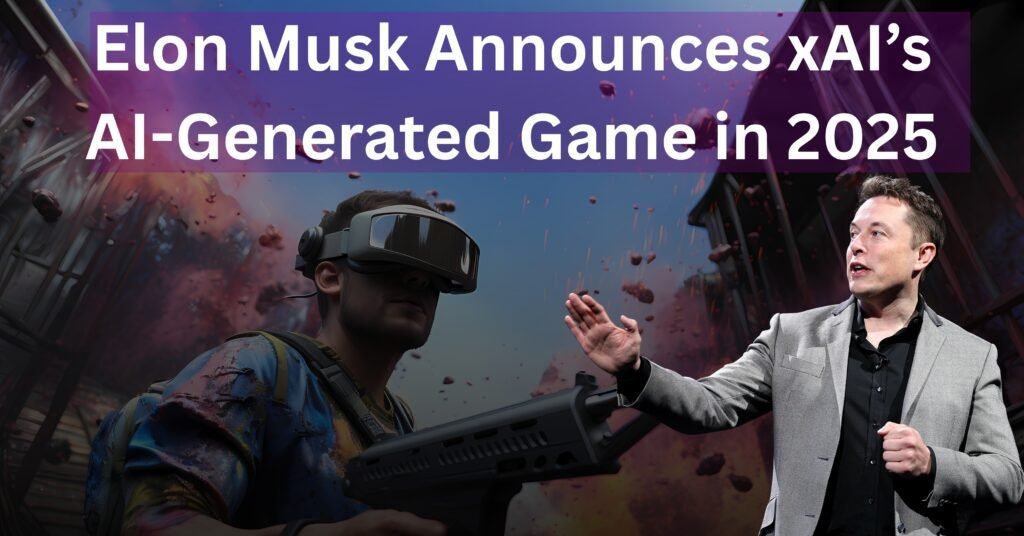
In a recent post on X (formerly Twitter), Elon Musk revealed a bold new ambition for his AI company xAI: it plans to launch a fully AI-generated video game before the end of next year. This announcement has generated excitement, skepticism, and a flurry of speculation about what “AI-generated” gaming really means, how plausible it is, and how it might reshape the intersection of artificial intelligence and entertainment.
In this blog, we’ll walk through:
-
What Musk has said so far
-
What exactly “AI-generated game” could mean
-
The current steps xAI is taking
-
Major challenges ahead
-
Possible scenarios and implications for the gaming industry
-
What to watch for next
What Musk Has Publicly Shared
 Here are the key bits of information we currently have:
-
Musk declared that “The xAI game studio will release a great AI-generated game before the end of next year.”
-
The target timeline suggests by end of 2026.
-
xAI is actively hiring “video games tutors” human experts who will help train and refine Grok (xAI’s AI) in game concepts, mechanics, storytelling, and design. The pay range is quoted as $45 to $100 per hour for such roles.
-
Job listings suggest these tutors will annotate, critique, and evaluate AI-generated game ideas for creativity, functionality, and engagement.
-
The announcement follows previous hints from Musk about launching a gaming studio under xAI.
So, while the public message is ambitious, the supporting moves are already underway hiring talent, collecting human feedback, and preparing the infrastructure needed to turn AI game generation from concept to reality.
What Does “AI-Generated Game” Actually Mean?
The phrase “AI-generated game” is broad and ambiguous. There are multiple ways AI can be integrated into game development, and unpacking that helps set realistic expectations.
Possibilities & Degrees of AI Involvement
-
Procedural Content / Level Generation
AI generates levels, maps, terrains, or environments dynamically something seen in many games already (e.g., “roguelikes,” open worlds). -
Asset / Art / Text Generation
AI creates textures, visual assets, character designs, dialogues, and narrative elements, either partially or fully. -
Mechanics / Rule Generation
AI suggests or designs new rules, game logic, balancing, or mechanics a more ambitious role. -
Dynamic Storytelling / Adaptive Narrative
The game changes its story arcs, quests, and dialogues in response to player actions in real time. -
Fully Autonomous Game Creation
From concept to execution, AI conceptualizes, builds, tests, and publishes a game with little to no human intervention. This is the most ambitious interpretation.
Musk’s phrasing (“great AI-generated game”) and the hiring of tutors suggest they may aim for something more advanced than just procedural generation, aiming at deeper creativity. But whether it will be fully autonomous or human-assisted remains uncertain.
Steps xAI Is Taking
Here’s what xAI is doing now to make this vision feasible:
Hiring Human Tutors / Experts
By bringing in game designers, critics, storytellers, and developers as tutors, xAI is ensuring that the AI learns not just from raw data, but from human judgment on quality, fun, and design.
This hybrid approach is common in AI systems: humans guide, filter, and correct the AI as it learns.
Infrastructure & Tools
To enable AI to generate games, both computational power and specialized tooling are needed: high compute clusters, simulation environments, game engines, feedback loops, and integration with AI models (e.g. Grok). Though Musk has not given full technical details, the hiring efforts and public statements imply that xAI is building or acquiring that infrastructure.
Prototype & Iteration
Before a full launch, xAI will likely release prototypes or pilot versions, test in controlled environments, refine mechanics, and iterate based on feedback (both internal and external). These steps are critical in game development.
Public Messaging & Branding
Musk’s announcement serves multiple purposes: gauging public reaction, attracting talent, preemptively claiming the narrative, and building hype. The bold vision helps attract attention from developers, investors, and media.
Challenges & Hurdles Ahead
The path from ambition to execution is filled with obstacles. Here are some of the biggest:
 Quality & Player Expectations
Games are judged on feel, balance, aesthetics, fun, and immersion. AI might generate content, but ensuring coherence, avoiding glitches, balancing difficulty, and providing meaningful experiences is hard. Many AI systems struggle with nuance, consistency, or surprise.
Creative Intent & Emotional Depth
Players often look for stories, themes, emotional resonance aspects that creative humans infuse. Can AI replicate that depth without being derivative or hollow?
Testing & Bug Fixing
Every game has bugs, exploits, edge cases, and unintended interactions. Human testing is essential. AI may help in test generation, but full reliability is hard.
Ethical, Copyright & Legal Issues
If AI learns from existing games, art, or code, there may be copyright, licensing, or plagiarism concerns. Also, generated content might inadvertently replicate patterns too closely.
Resource & Cost Constraints
The compute, storage, and talent cost to train AI models capable of generating games at scale are enormous. Ensuring the economics work (cost vs revenue) is challenging.
Community, Adoption & Trust
Gamers are discerning. If the AI game feels shallow or buggy, backlash is likely. Also, convincing developers, publishers, and platforms to accept an AI-generated title is nontrivial.
Possible Scenarios & Outcomes
Here are a few realistic paths this project might take:
-
Hybrid AI + Human Game
AI creates core content (levels, assets, narrative skeleton), humans refine, polish, fix, and shape the final product. This is the most plausible near-term model. -
Limited Genre / Casual Games First
The first AI game might be simpler casual, puzzle, platformer where complexity is manageable rather than massive open-world fully 3D RPGs. -
Modular / Adaptive AI Content
Perhaps the core engine is handcrafted but AI fills in details, side content, dialogs, emergent events, etc. -
Experimental / Proof-of-Concept Launch
Rather than a blockbuster, the first release might act as a showcase or demo to prove the concept and attract further investment and public experimentation. -
Platform / Tool Release Instead of Full Game
xAI might release a gaming engine or AI-as-a-tool for other developers, letting them generate parts of games themselves.
Implications for the Gaming & AI Industry
 If successful, xAI’s venture could have ripple effects:
-
Democratizing Game Creation
Lower barriers to entry small studios or individuals could use AI tools to build better games. -
Shifting Roles in Game Dev
Designers and artists may shift from creating base content to supervising and curating AI outputs. -
New Standards for Procedural & Adaptive Games
The line between static design and real-time generation could blur further. -
Competition & Innovation Pressure
Traditional studios may accelerate AI adoption; others may fight to protect creative uniqueness. -
Regulation & Standards
As AI in content creation grows, legal and ethical frameworks (copyright, attribution, content safety) will become more pressing.
What to Watch Next: Key Milestones & Signals
Here are the developments to keep an eye on:
-
Early Prototype or Demo Release — A teaser version or minimal playable build
-
Job Listings / Staff Growth in Gaming Division — More hires, especially in design, QA, tools
-
Technical Deep Dives / Whitepapers — Details about architectures, pipelines, model training
-
Partnerships with Game Engines / Studios — Collaborations with Unity, Unreal, indie devs
-
Community Feedback / Beta Testers — Will open to testers, collect feedback, adjust
-
Monetization Model — How will the game be sold or monetized (one-time purchase, subscription, in-game monetization)
Elon Musk’s announcement that xAI is targeting a fully AI-generated game by the end of next year is audacious and visionary. The road ahead is steep and full of technical, creative, and business challenges. But the steps xAI is already taking hiring gaming tutors, preparing infrastructure, signaling intent suggest this is more than just headline bait.
Whether xAI will succeed in creating a game that can truly rival human-crafted titles remains to be seen. But even if the first versions are imperfect, this push could accelerate how we think about AI in creative industries, especially gaming. To know more Jatininfo.in now